
DEX Timezone Handling
This topic explains how DEX standardizes local device time zones when calculating metrics, historical trends, and event timestamps across global endpoints.
To ensure consistent global reporting, DEX relies on standardized IANA timezone identifiers (for example, Europe/Rome) reported by each endpoint. Internally, system data is stored in two formats:
- historical daily data is recorded purely as calendar dates
(
YYYY-MM-DD) collected at local endpoint midnights - real-time anomalies, events, and granular metrics are stored strictly in Universal Coordinated Time (UTC). At the presentation layer, all data is rendered relative to the target device’s local timezone (“Client” time): the front end dynamically converts stored UTC timestamps into the endpoint’s local timezone when displaying high-resolution graphs of a single device.
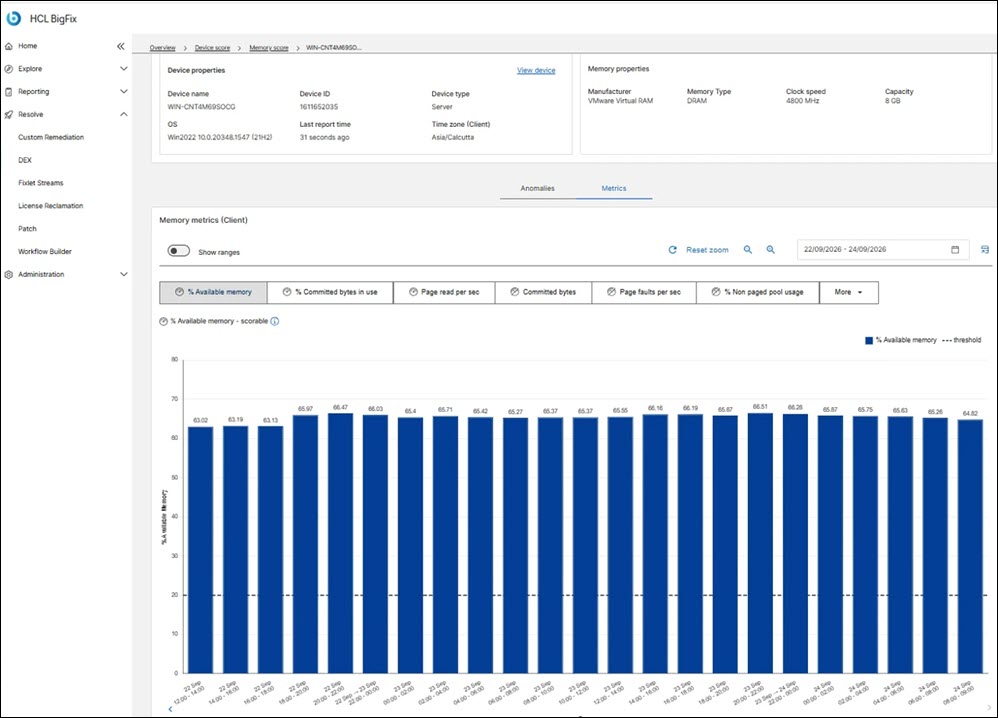
An example of memory metrics for a device located in Asia/Calcutta IANA Timezone.
Note: The reported IANA timezone identifier for example,
Europe/Rome denotes a standard time zone region rather than the device's exact
physical location. IANA naming conventions use a primary representative city to
apply uniform offset and Daylight Saving Time (DST) rules across an entire region.
Devices operating within the same time zone follow identical local time conversions,
regardless of the specific representative city name assigned.