
Application score
An Application Score is the key performance indicator that quantifies the stability, performance, and usability of the software applications your employees rely on every day.
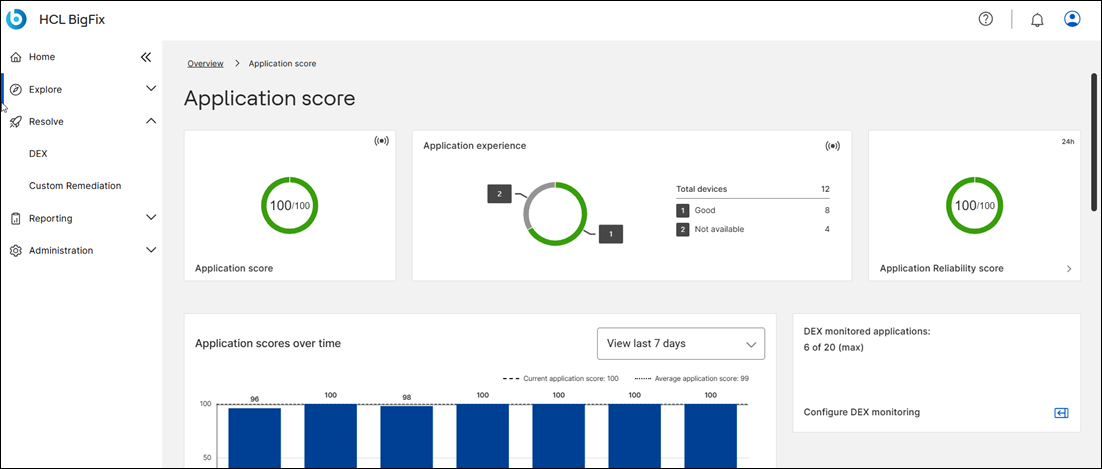
Using the Application Score, users can enable or disable monitoring for specific applications within the DEX dashboard. By default, a maximum of 20 applications are supported to avoid over-stressing client systems. The page provides a comprehensive data about the device health, including reliability scores and historical data over a 30-day range and on-demand.
Application Score is calculated as average score over all devices (reporting to Dex and having at least one application running). Application experience gives the count of devices in each experience category (Good, Fair or Bad), depending on its score.
Application Score is calculated for each application version individually.
The Application Score is computed based on the following operational parameters:
- Application Performance: Evaluates real-time processing and execution constraints of running software.
- Application Reliability: Tracks application stability, process hangs, and critical application faults.
- Capacity Stability: Measures the runtime stability and resource constraints when scaling multiple concurrent processes.
Underlying leaf scores:
The Application score is computed as a combination of the scores from all applications. The current list of Application Leaf scores takes into account Application Reliability Score which has the following list of events and metrics:
- App CPU Usage
- App Memory Footprint
- Application Crash
- Process Hang
The platform tracks software health across to allow two types of computation:
- 24-hour: The dashboard shows data aggregated from the last 24 hours.
- Historical data: The historical application score trend over time across the last 7 days and last 30 days
Application Reliability score
The Application Reliability Score is a provides a view of the scores in the group of endpoints for a selected application.
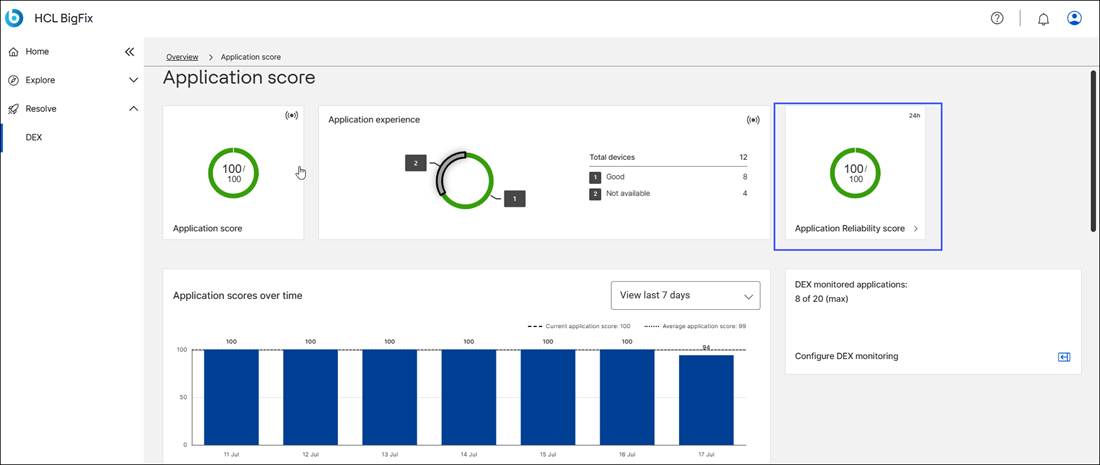
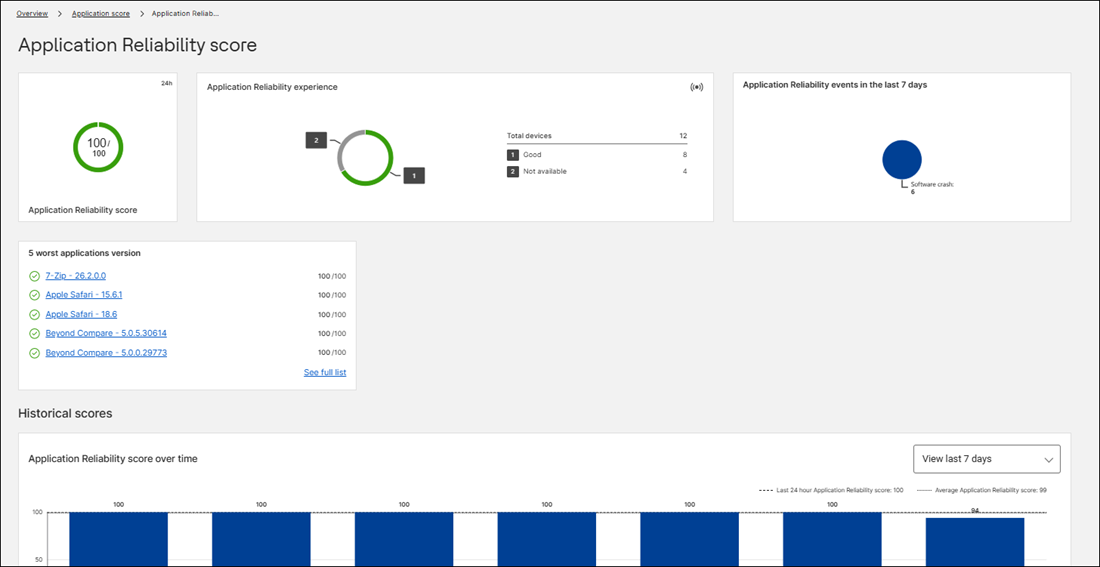
Scroll down to "Devices with worst Application Reliability score"
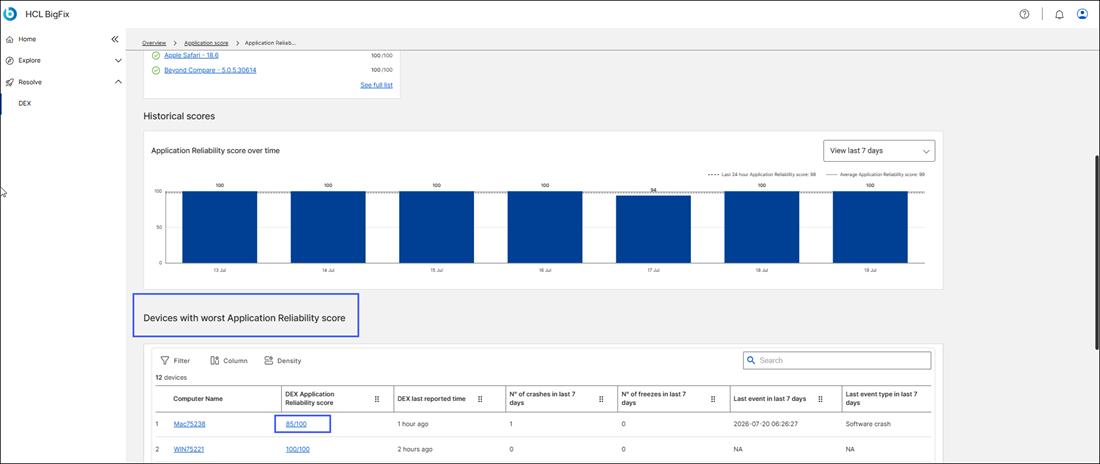
When you click on a single endpoint, you reach the single endpoint view with the application reliability scores, metrics, events, and anomalies.
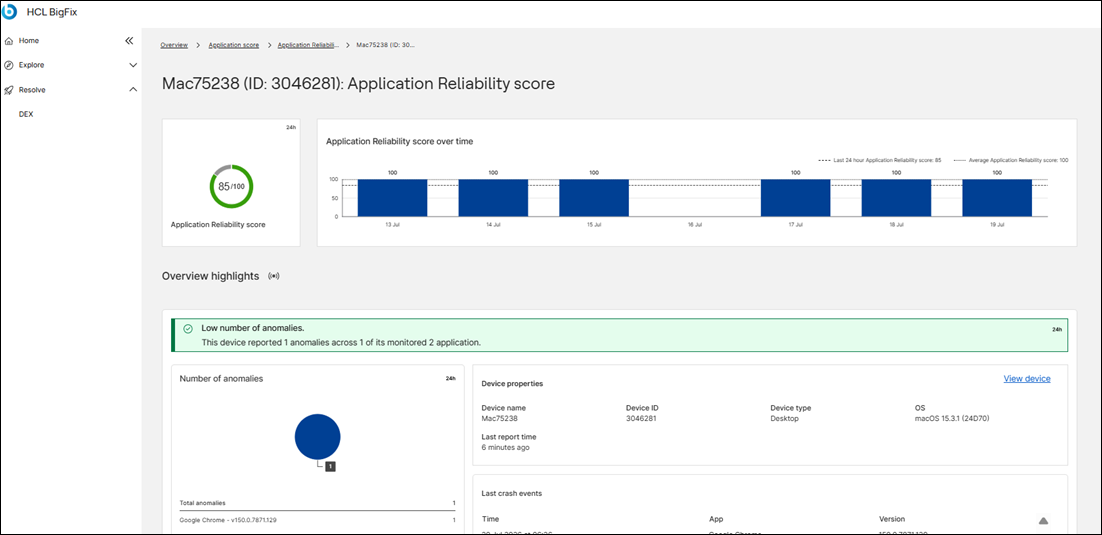
Application Reliability Metrics
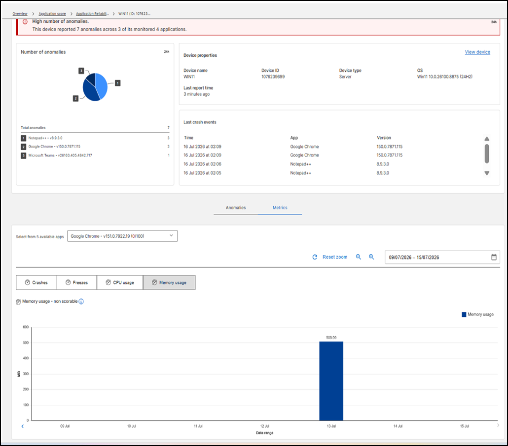
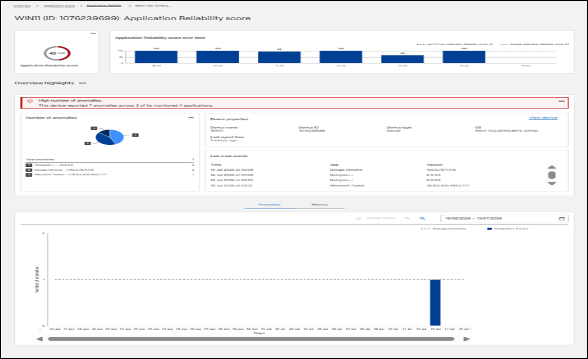
For each application and version running on an endpoint, DEX monitors four key metrics: Application crash, Application freeze, CPU usage, and Memory usage. Application crash generates anomalies based on the number of crashes, while Application freeze tracks the number of times an application becomes unresponsive and generates corresponding anomalies. Unlike CPU and Memory usage, which are non-scorable metrics that may trigger OD flows for greater granularity—crashes and freezes function mainly as event-driven metrics that can incur a score penalty. Within the UI widget, users can select the specific application and version to monitor, with the flexibility to track multiple versions of the same application on a single endpoint. To enable this, the DEX Endpoint Plugin automatically detects and reports when monitored applications become unresponsive on both Windows and macOS endpoints by evaluating OS-generated freeze reports, specifically Windows Event Log entries (Event ID 1002) and macOS .hang diagnostic reports. Similar to the Device score, the interface features all anomaly widgets including textual, graphical, and application/version-specific anomaly views alongside a list of the most recent events.
Enabling or disabling Application Monitoring
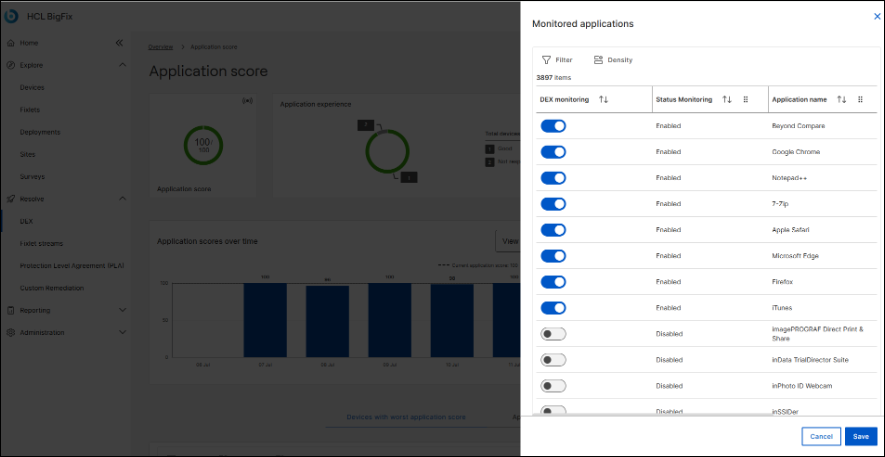
To configure the DEX monitoring on the set of applications, you can enable or disable the application from the DEX monitored applications widget.

When you toggle the DEX monitoring button on the DEX monitored application list, you are able to enable or disable application monitoring.