
Product overview
This module provides comprehensive guidance on the installation, maintenance, and operation of the IVR v.4 service. It includes a detailed summary of the entire end-to-end workflow for using IVR v.4.
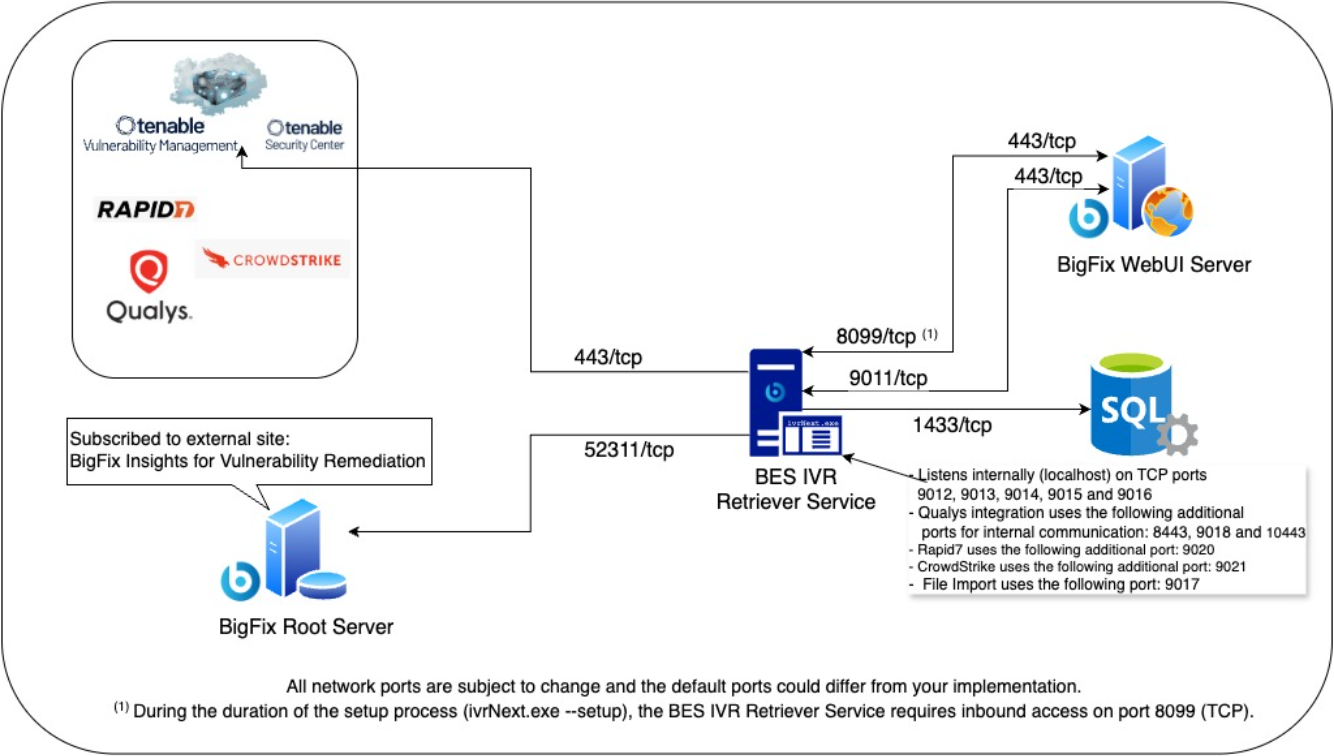
The IVR4 is an advanced solution designed to bridge the gap between vulnerability detection and remediation actions, significantly improving the speed, accuracy, and efficiency of addressing security vulnerabilities. By integrating vulnerability data from scanners with BigFix remediation capabilities, IVR helps organizations resolve vulnerabilities faster. IVR v.4 supports Tenable, Qualys, Rapid7, and CrowdStrike, providing flexibility to choose your preferred scanner.
Key features of the IVR v.4 include:
- Improved Vulnerability to Remediation Correlation: Traditionally, the correlation between Tenable's vulnerability findings and BigFix's remediation content was based on CVE IDs (Common Vulnerabilities and Exposures), which often resulted in delays and inaccuracies. IVR4 uses a rule-based system that leverages various scanner plugin attributes, such as the xref type, for more precise correlation. Moreover, IVR4 now provides a continuously updated, pre-correlated mapping between scanner plugins and BigFix Fixlets, leading to faster and more accurate remediation guidance.
- Enhanced Asset Correlation: Previously, scanner assets were matched to devices in BigFix based on IP addresses, MAC addresses, or hostnames, which caused issues due to changing IP addresses or devices with multiple network adapters. With IVR4, the system directly leverages unique scanner asset identifiers—including BigFix Asset IDs provided by Tenable and Qualys, Rapid7 Host IDs, and CrowdStrike Agent IDs collected via dedicated discovery tasks and the IVR Vulnerability Scanner Host ID analysis—improving the accuracy and speed of asset correlation. This approach eliminates challenges associated with virtualization and devices that have dynamic or multiple network connections.
- Reduced Infrastructure Requirements: A significant challenge with the legacy IVR was the need for substantial infrastructure, requiring customers to deploy and maintain both the BigFix Insights component and dedicated SQL databases, complex ETL configurations, and heavy resource management. The IVR v.4 architecture completely decouples the IVR Retriever service from BigFix Insights, eliminating the dependency on the Insights database and streamlining overall deployment. Furthermore, IVR 4.4 introduces built-in proxy server support, enabling secure outbound connectivity to external vulnerability management platforms (Tenable, Qualys, Rapid7, and CrowdStrike) without requiring complex direct network routing or additional gateway hardware. This standalone design significantly reduces server resource requirements, lowers operational costs, and accelerates time-to-value.