
Customization and Extension Framework
The canonical model is intentionally designed to allow controlled customization without compromising the standardized architecture. Extensions are managed through a structured framework that maintains consistency across implementations and subject areas.
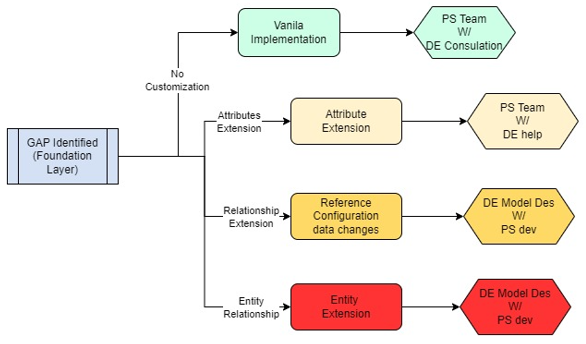
Levels of Customization
Level 0: No Customization (Strict Canonical)
Description: Use the canonical model exactly as defined. Apply only standard transformations.
When to Use: When subject areas perfectly match canonical definitions.
Scope: No structural changes; configuration only through metadata tables.
Example: Party subject area typically requires minimal customization.
Roles played: PS Teams leads vanilla implementation as per the redbook with consultation with DE for any support needed.
Level 1: Attribute Extension (Low Impact)
Description: Add new attributes to existing canonical entities using the flexible ATTRIB_* columns.
When to Use: When adding a few client-specific or domain-specific attributes.
Scope: Limited to 5 flexible attributes per entity (attrib_1 through attrib_5).
Example: Adding a "customer_segment_code" attribute to the Party entity.
Roles played:
- Tech BA - Gaps identified through foundation layer for attributes to be added.
- DE - Identifies the requirement, changes the model, and generates LDZ - RDV code through meta data model.
- Implementation Team - works with the Tech BA / DE team and develops ETL accordingly.
Level 2: Relationship Extension (Medium Impact)
Description: Existing Reference values do not map with the Client specific values and GAP identified to make changes accordingly.
When to Use: Inherent reference data values (i.e. account type) has separate reference set from client side
Scope: Map the reference values with existing one and generate any snippet changes that refer to reference values.
Example: Event names are indifferent for clients and they need to club, map in standardized form to map into 360 calculations.
Roles played:
- Tech BA: Gaps identified through foundation layer that identifies Impact on existing Reference data.
- DE -
- Analyzes overall impact and list out of plan of action with estimated changes required
- Provides change development requirement to PS
- Provides specific data changes to PS
- Provides changes in 360s if needed
- Implementation Team:
- Works with the Tech BA / DE team to understand the Development requirement.
- Develops ETL according to the data structures created through change in data entities and ETL.
Level 3: Entity Extension (High Impact)
Description: Add entirely new entities (Hubs) not in the canonical model.
When to Use: When a completely new subject area or business entity is required.
Scope: Creates new Hub table with corresponding Link and Satellite tables.
Example: Adding a Partner/Vendor entity for B2B use cases.
Roles played:
- Tech BA: Gaps identified through foundation layer that represents list of additional entities and its relationships
- DE -
- Identifies model changes, works with Stakeholders and BA to finalize the changes
- Changes models under client specific version
- Generates LDZ - RDV code through meta data model by making meta data entries
- Changes 360s to absorb the required enhancements across feature lists.
- Implementation Team:
- Works with the Tech BA / DE team to to review and finalize the changes.
- Prepares ETL bespoke additional development requirement.
- Develops ETL according to the data structures created through change in the model till LDZ.
PS Team - ETL Pipeline Performance
ETL pipeline execution performance may vary across client environments depending on several implementation-specific factors, including data volumes, infrastructure sizing, database platform, storage architecture, workload concurrency, resource allocation, and defined SLA expectations.
The product implementation includes standard optimization practices and recommended processing patterns out of the box; however, additional tuning, workload balancing, indexing strategies, infrastructure scaling, and execution optimizations may be assessed during implementation phases by the PS team to align overall pipeline performance with client-specific operational requirements and target SLAs.