
HCL MaxAI CDM integration and Usage with Unica+ Products
Integration with MaxAI and CDP/External Systems:
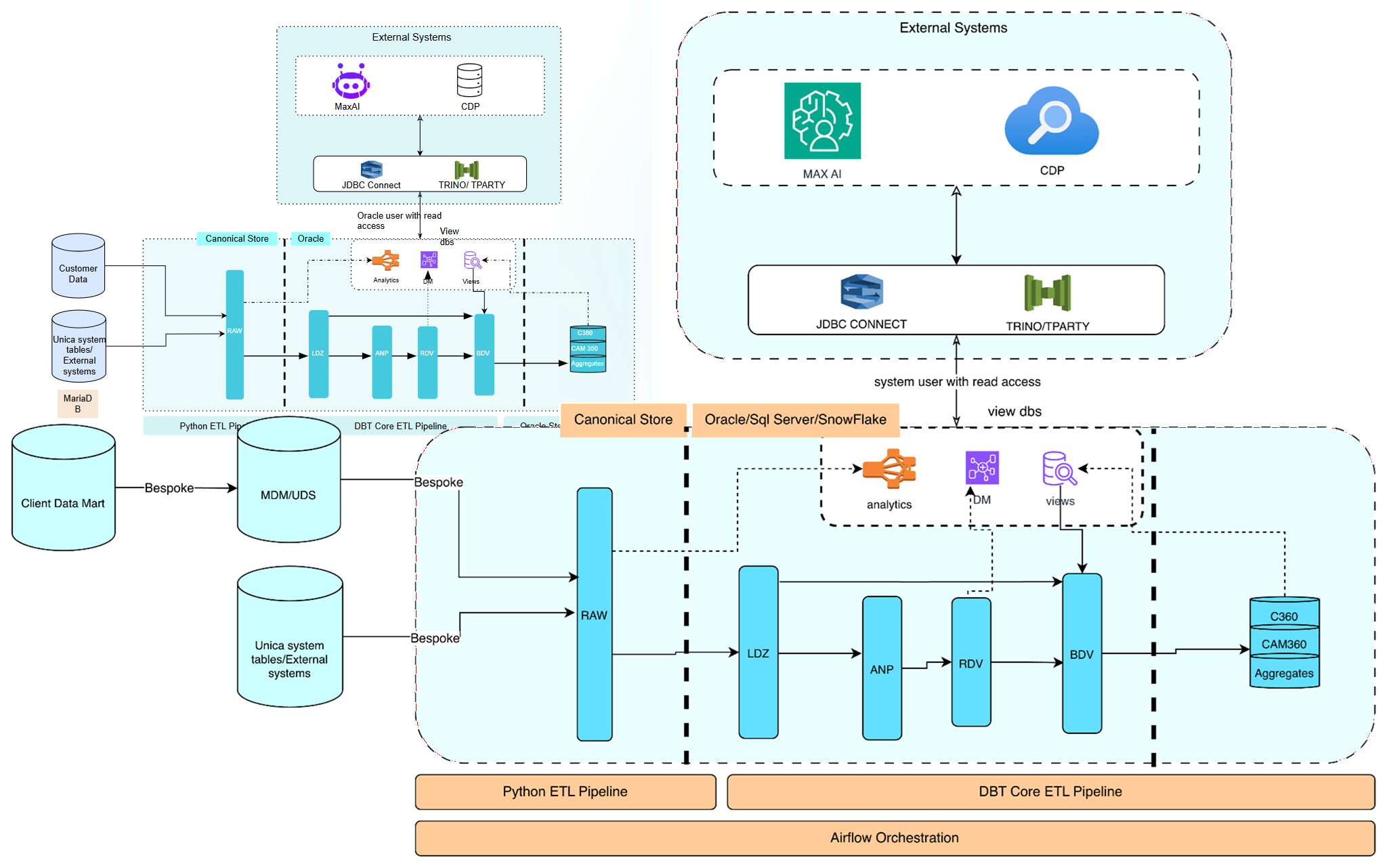
The Campaign subject area integrates with the Canonical Data Model through a metadata-driven pipeline that ingests source campaign data, transforms it to canonical Campaign entity structures, and exposes it downstream via Unica 360 Campaign 360.
Campaign Data Flow:
- Source Systems: Campaign data ingested from source systems (marketing automation platforms, campaign management systems)
- Landing Zone (LDZ): Raw campaign records staged in ldz_campaign_* tables preserving source structure
- Raw Data Vault (RDV): Campaign entities implemented as h_campaign (Hub), l_campaign_* (Links), and s_campaign_* (Satellites) following Data Vault 2.0 patterns
- Metadata-Driven Transformation: metadata model define source-to-canonical mappings for campaign attributes (campaign_id, campaign_name, campaign_type, campaign_status, budget, objective, target_audience)
- Campaign 360: Derives key performance metrics using pre-aggregated 360 tables and simple, standardized formulas applied to campaign-level contact and activity data. It provides a comprehensive, curated set of measures across audience size, engagement, responses, conversions, and cost attribution, enabling consistent evaluation of campaign effectiveness, ROI, and cross-channel behavior. Flowchart 360 complements Campaign 360 by providing flowchart-level execution insights, including detailed tracking of flow performance, audience reach, and channel-level engagement. This capability leverages canonical campaign and flowchart execution data to enhance analytical capabilities by enabling flow-level performance tracking, and serves as a valuable input for advanced analytics and AI-driven optimization use cases within MaxAI
Campaign Redbook Reference:
The Campaign Redbook serves as the authoritative documentation for campaign entity definitions, attributes, relationships, and transformation rules. It is maintained in parallel with the Metadata Model and provides business context for all campaign data.
- Entity Definition: Campaign Hub contains persistent campaign keys and core identifiers
- Relationships: Links capture campaign-party (targeting), campaign-offer (promotion assignments), campaign-channel (execution channels)
- Attributes: Satellites track campaign goals, budgets, performance metrics, status, and business metadata
- Reference Location: Campaign Redbook (for documentation reference and business context validation)
Agentic Segmentation via 360
The Canonical Data Model acts as the unified data backbone for the Customer Data Platform through 360 views. The CDP leverages Customer 360 view to deliver comprehensive customer resolution, audience segmentation, and campaign orchestration capabilities.
- Customer Attributes: Customer 360 aggregates unified customer profile, demographics, risk & compliance indicators, consent preferences, verified contact details, financial holdings, behavioral transaction metrics, multi-product engagement, campaign interactions (7D/30D), and conversion performance.
- Relationship Hierarchies: Customer-to-account mappings for comprehensive view.
- Real-time Updates: Metadata-driven CDC processes stream customer changes to CDP for real-time personalization.
Canonical-to-CDP Data Flow:
- Ingestion: Customer source data (CRM, loyalty, transactional) ingested via LDZ.
- Unification: RDV Hub-Link-Satellite structures implement Party and Relationship canonical entities.
- Customer Resolution: Metadata-driven correlation rules resolve customer records across systems.
- Enrichment: Customer 360 adds calculated attributes (RFM, CLTV, engagement scoring).
- Activation: CDP reads Customer 360 to power segment definitions.
MaxAI Integration: Customer/Campaign Analytics
MaxAI leverages Customer 360 and Campaign 360 views to deliver AI-powered insights, advanced analytics, and intelligent recommendations. The integration transforms customer and campaign data into actionable intelligence that helps marketers understand customer behavior, evaluate campaign effectiveness, and improve marketing outcomes. For more information, refer HCL MaxAI CDM Redbook.
- Leverages unified Customer 360 and Campaign 360 views to generate high-quality analytical insights and recommendations.
- Provides descriptive and diagnostic analytics across customer behavior, campaign performance, channel effectiveness and Campaign level outcomes.
- Highlights response patterns based on customer attributes, segmentation criteria, and historical campaign interactions.
- Enables cross analysis of customer behavior and campaign execution data to identify trends, correlations, and oppurtunites for optimization.
- Delivers natural-language responses to analytical questions through MaxAI Insights.
- Provides data quality and data volume insights by identifying anomalies and trends within Customer 360 and Campaign 360 datasets.
MaxAI Integration: Campaign AI (Replication/Custom Flowchart)
Campaign AI leverages Campaign 360 and Flowchart 360 views to provide contextual intelligence for AI-assisted campaign creation, optimization, and execution. These views consolidate campaign definitions, flowchart configurations, audience information, campaign history (CH), and response history (RH), enabling Campaign AI to understand historical marketing activities and recommend effective campaign strategies.
The integration transforms campaign and response data into reusable campaign knowledge, allowing marketers to accelerate campaign design and improve execution consistency.
Campaign AI Capabilities Powered by Campaign 360 and Flowchart 360- Uses Campaign 360 and Flowchart 360 data, including campaign history (CH), response history (RH), flowchart configurations, and audience information, to support AI-assisted campaign generation and recommendations.
- Leverages historical campaign execution patterns and response outcomes to provide context-aware campaign recommendations.
- Assists users in creating campaign artifacts based on previously executed campaigns and associated flowcharts.
- Recommends audience targeting approaches using historical campaign and response data.
- Supports generation of campaign strategies, campaign configurations, and flowchart designs based on historical campaign knowledge.
- Enables reuse of successful campaign patterns and marketing best practices captured within Campaign 360 and Flowchart 360.
- Provides a unified view of campaign definitions, flowchart structures, campaign history, and response history to support campaign planning and execution.
- Supports campaign optimization by utilizing historical response behavior and
campaign outcomes when generating recommendations.Note: Flowchart 360 historical data is generated only for flowcharts that contain engagement-related metrics. Flowcharts without engagement data are excluded from historical replication and subsequent Campaign AI processing.
| Insights Reporting (Planned for future release): Generates reports, charts, and campaign metrics within Unica. Interprets KPIs, graphs, and dashboards to generate human-readable insights (e.g., "Conversions increased 15% last week due to SMS channel performance"). Supports follow-up conversational queries for deeper exploration. Helps marketers make data-driven decisions without needing SQL or analytics expertise. |
CDM-ML Model Integration
- The CDM–ML Feature Integration framework establishes a standardized, bidirectional interface between the Canonical Data Model (CDM) and Machine Learning (ML) pipelines, enabling seamless feature consumption, model execution, and activation of ML-driven insights across the Unica ecosystem.
- CDM acts as the authoritative feature provider, where Customer 360 data and derived ML features are consolidated and exposed via a controlled publish layer. Model-specific views provide point-in-time–consistent feature inputs for training, retraining, and BAU scoring pipelines, ensuring feature parity and eliminating duplication of logic across ML workflows.
- ML models consume these features independently and generate predictions such as Next Best Channel (NBC) and Send Time Optimization (STO). These outputs are ingested into CDM through a dedicated ingestion layer, where they are stored in a structured, query-optimized format to support scalable access patterns.
- An enrichment pipeline then integrates these ML predictions back into the Customer 360 layer, updating relevant attributes with the latest NBC and STO outputs. This ensures that ML-driven recommendations become part of the unified customer profile and are readily accessible to AI agents.
- The architecture enforces:
- Separation of concerns between feature generation (Data Engineering) and model execution (Data Science)
- Consistent data contracts across training, retraining, and scoring pipelines
- Incremental, watermark-driven processing for scalability
- Closed-loop integration, where ML outputs are operationalized within CDM and continuously improve downstream decisioning
- This approach positions CDM as not just a data repository, but a central intelligence layer, enabling scalable, ML-driven personalization and decisioning across all customer engagement touchpoints.
ML Pipeline Integration with CDM
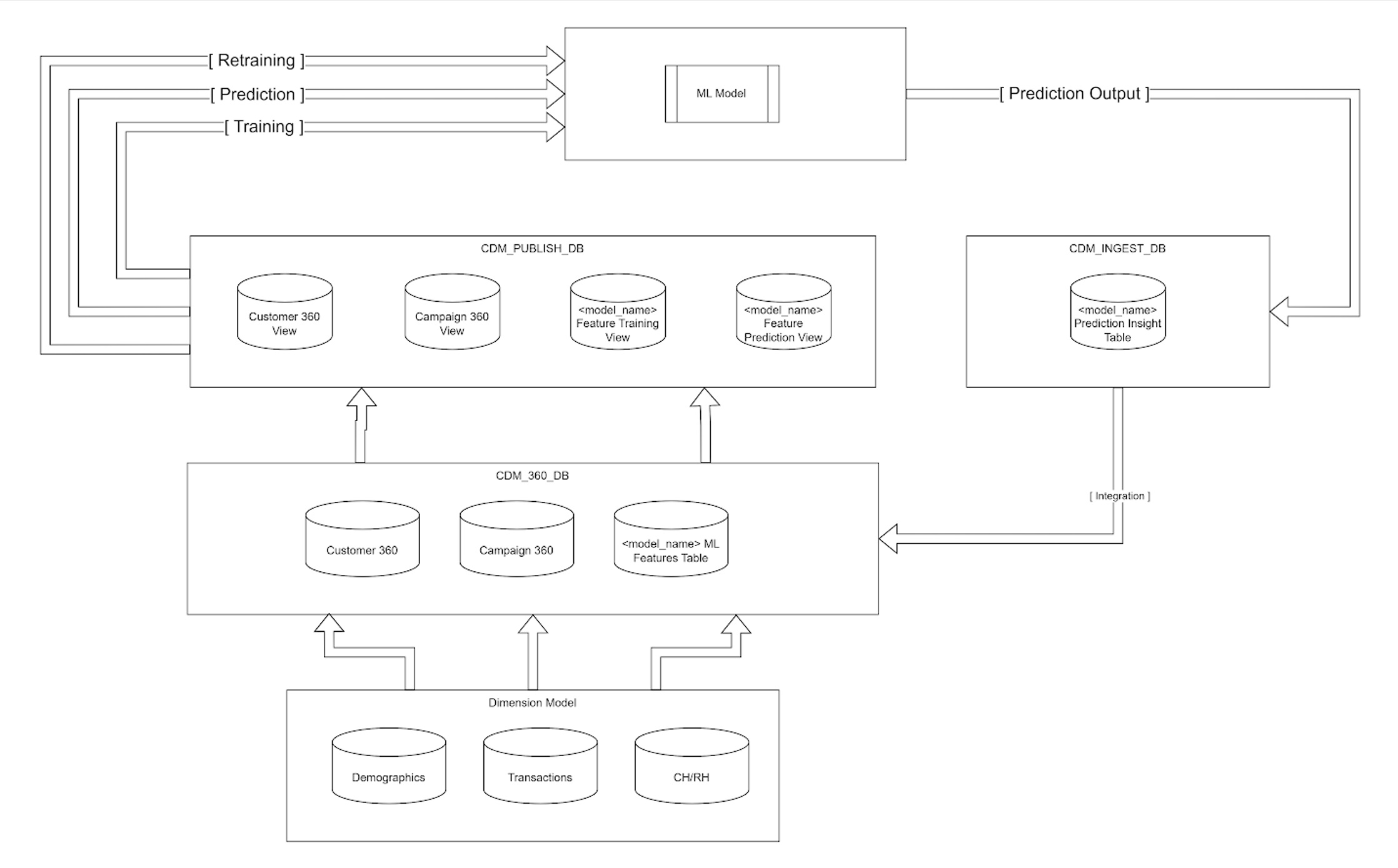
CDM provides the data integration framework required to support ML model training, retraining, prediction, and downstream activation workflows. CDM acts as the system responsible for provisioning ML-ready feature datasets, exposing model-specific feature views for ML consumption, and ingesting ML prediction outputs,and enriching Customer 360 with ML-generated insights.
The actual ML model implementation, training logic, retraining logic, and prediction execution pipelines are external to CDM and are owned by the ML/Workbench framework.
Built-in CDM Support for ML Pipelines :
CDM provides the following built-in capabilities for ML integration:
- Model-specific ML feature tables in CDM_360_DB
- Model-specific Training and Prediction feature views in CDM_PUBLISH_DB
- Incremental feature generation pipelines
- Prediction output ingestion tables in CDM_INGEST_DB
- Customer 360 enrichment pipelines for ML prediction activation
These components collectively provide a standardized interface between CDM and external ML pipelines.
Training Pipeline Support :
For each supported ML model, CDM exposes a <model_name>_Feature_Training_View in CDM_PUBLISH_DB.
This view:
- Exposes all required ML input features
- Includes target/label attributes where applicable
- Provides point-in-time feature datasets for model training and retraining
- Abstracts underlying feature derivation complexity from ML pipelines
Training pipelines consume this view to prepare training datasets and train the ML model externally.
Retraining Pipeline Support:
- Retraining pipelines use the same training feature view exposed through CDM_PUBLISH_DB.
- Retraining frequency and execution schedules are controlled externally by the ML framework based on model governance and operational requirements.
- CDM regularly refreshes feature datasets to ensure retraining pipelines always have access to the latest eligible feature data.
Prediction Pipeline Support :
For each supported ML model, CDM exposes a <model_name>_Feature_Prediction_View in CDM_PUBLISH_DB.
This view exposes only inference/prediction input featuresc, excludes training target attributes, and provides incremental feature updates for business-as-usual prediction execution.
Prediction pipelines consume this view and generate model predictions externally through the ML framework.
Prediction outputs are written back into model-specific prediction insight tables in CDM_INGEST_DB.
Delta Processing for Prediction and Retraining:
CDM feature pipelines regularly (currently daily) refresh model feature datasets based on underlying source data changes.
Prediction and retraining pipelines are expected to process feature datasets incrementally using feature update timestamps or equivalent execution tracking mechanisms defined by the ML framework.
The detailed orchestration and execution handling logic for ML pipelines is outside CDM scope and is managed by the ML/Workbench framework.
Customer 360 Enrichment
Prediction outputs written into CDM_INGEST_DB are integrated back into Customer 360 through CDM enrichment pipelines. This enables ML-generated insights such as Next Best Channel (NBC), Send Time Optimization (STO), and other future prediction outputs to become directly available for downstream activation, personalization, campaign execution, journey orchestration, and AI-driven decisioning.
Workbench Guide Reference
The detailed implementation of the following are documented in the Workbench Guide and this document link is there in appendix:
- ML model lifecycle management
- training orchestration
- retraining orchestration
- prediction execution
- execution scheduling
- API processing
- Operational controls
The CDM Guide documents only the CDM-owned integration interfaces, feature provisioning mechanisms, ingestion contracts, and Customer 360 enrichment flows related to ML integration.
Canonical-to- 360-to-MaxAI Data Flow
- Canonical Data Model Standardizes Inputs: All source data is harmonized into a unified, normalized structure.
- Feature-Ready Integration: Canonical entities carry consistent business keys and relationship maps.
- Audience Resolution Layer: The Audience Resolution Layer introduces a standardized framework for resolving campaign audiences across multiple audience grains, including customer, account, and device levels. The layer leverages the Audience_map structure and Campaign–Offer–Channel–Product bridge relationships to establish consistent audience mappings across campaign execution and analytical workloads. By creating a unified audience resolution mechanism, the layer enables Campaign 360 and Flowchart 360 to accurately associate campaign activity, engagement metrics, and response outcomes with the appropriate audience context. This capability supports multi-audience campaign execution, agentic cross-domain analytics, and AI-driven campaign optimization while maintaining a consistent audience representation across the Canonical Data Model ecosystem.
- Customer 360 Construction: Canonical records aggregated into a longitudinal, behavior-rich customer profile.
- Campaign 360 Construction: Canonical campaign, offer, treatment, and contact history assembled into complete campaign life-cycle views. Both Campaign 360 and Customer 360 now consume data from a pre-computed Aggregate Layer, eliminating direct BDV snapshot reads and enabling efficient incremental processing.
- Flowchart 360 Construction: Flowchart execution data aggregated to provide flow-level performance insights, audience reach, and channel-level engagement metrics.
- Cross-Domain Joining: Customer 360 and Campaign 360 fused for full visibility into customer behavior across every campaign touch-point.
- Analytical Layer Preparation: Aggregations, time-series transformations, feature windows, and derived KPIs created for insights and ML readiness.
- MaxAI Insight Engine: Consumes 360-layer datasets to answer analytical questions, detect patterns, surface performance drivers.
- AI-Ready Metadata Exposure: Canonical and 360 structures expose standardized attributes, entities, and lineage, enabling MaxAI to interpret intent and retrieve accurate insights.
- Foundation for Predictive Automation: Establishes a reliable, governed data fabric for agentic segmentation, propensity scoring, Next Best Channel (NBC), Send Time Optimization (STO), campaign optimization, and AI-driven decisioning across customer engagement touchpoints.
Integration Summary Matrix
| Integration Point | Primary Unica 360 Views | Key Capabilities | Reference Documentation |
|---|---|---|---|
| Campaign AI | Campaign 360 Flowchart 360 (Flowchart 360 is nested within Campaign 360 and extends campaign insights with detailed flowchart-level visibility.) |
Campaign performance metrics, multi-channel execution | Campaign Redbook |
| Customer Data Platform (CDP) | Customer 360 | Agentic segment activation | CDP User Guide |
| MaxAI | Customer 360 Campaign 360 |
Analytical insights, Cross domain analytics, intelligent segment discovery and refinement | MaxAI Implementation Guide |
| Metadata Model (CORE) | All 360 Views | Integration orchestration, transformation rules, data quality, lineage tracking | Metadatamodel.ddl |
| ML Model | Customer 360 + ML Model | Next best Channel (NBC) , Send Time Optimization (STO) | NA |
Integration Conclusion
The Canonical Data Model, implemented through the three-layer architecture (LDZ, RDV, Unica 360) and orchestrated by the Metadata Model, provides a unified, extensible foundation for enterprise customer data management. By integrating Campaign, and MaxAI systems, organizations achieve:
- Rapid Integration: Metadata-driven architecture enables new integrations without code proliferation
- End-to-End Lineage: Complete tracking from source through transformation to activation
- Intelligent Automation: MaxAI leverages unified data for insights, validation, and segment recommendations
- Scalable Growth: New subject areas and integrations onboard via metadata configuration
- Compliance & Governance: Centralized data quality, lineage, and audit trails for regulatory requirements