
Integration with ANSIBLE Inside
To manage / onboard Ansible Inside as the RBA tool, perform the following steps:
- On the left menu bar, click Runbooks, and then click Manage Runbook Tool. The Manage Runbook Tool appears.
- Click Add New to add a new tool or click to edit an existing runbook automation tool.
- Select Organization for which you need to create a runbook tool in the Organization Name field.
- Type the runbook tool name in the Runbook Tool Name field.
- Select ANSIBLE Inside from the Runbook Tool Type drop-down.
- Select REST API as the integration method for ANSIBLE Inside for the Integration Method
field.
Figure 1. Manage Runbook Tool (Cont.) 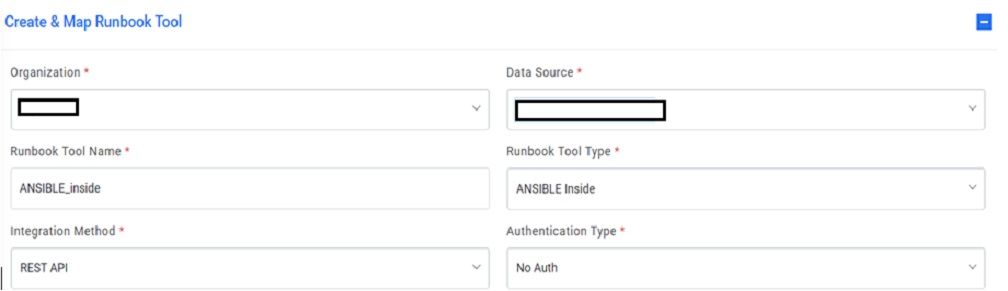
- Select one of the Authentication Type from No Auth, Certificate Based Auth, or
Token Auth.
- Selection of No Auth, Certificate Based Auth as Authentication Type will not require any user id or password.
- Selection of Token Auth as Authentication Type requires you to enter –
- Authentication URL: URL of iAutomateAPI to generate token.
Figure 2. Manage Runbook Tool (Cont.) 
- Provide the API URL of the tool.
- Select ‘POST’ in the Integration Method Type field.Note:API URL is dependent on the selected integration method.
- Specify the path to get the consolidated scripts for the execution of runbooks in the
Master Runbook Path field. This will be provided by
respective Runbook Tool teams if they have a master runbook.Note:This is not a mandatory field. Users can change and run these scripts any time.
- Select Proxy Required, if the environment needs access to content from servers outside a firewall.
- Type the return code key in the Return Code Key field to identify the success or failure of runbook execution. E.g. status_codes
- Type the return message key in the Return Message Key field to display the success or failure of runbook execution. E.g. iAutomate_success
- Type the Toil Value (For Manual Execution) which implies the manual execution time of runbook under this tool (in minutes).
- Type the Toil Value (For Auto Execution) which implies the auto execution time of
runbook under this tool (in minutes), if available else it’s a non-mandatory field.
Figure 3. Manage Runbook Tool (Cont.)
- Type the Python Execution Path which will remain constant as ‘python’.
- Type the SDK Python Script Location which is the Location of the core python script of Ansible-Inside that manages the execution of Ansible roles.
- Type the Master Playbook Location which is the Location that will host the master yaml within the Ansible-Inside setup.
- Type the Ansible Playbook Directory which is the Location that will host all the ansible roles to be executed within the Ansible -Inside setup.
- Type the Request Log Path which is the location where all log files will be created.
- Type the Vault Key which is used to securely access the tool.
Figure 4. Manage Runbook Tool (Cont.) 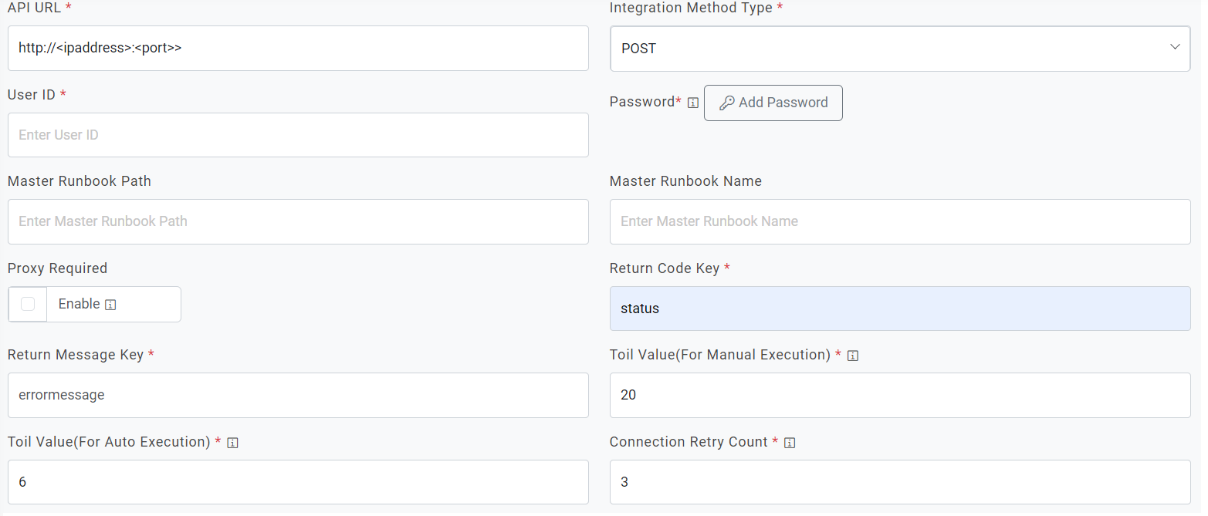
- Click Submit / Update for adding a new tool or making changes to an existing tool.
An appropriate success message will be displayed.Note:The fields SDK Python Script Location, Master Playbook Location, Ansible Playbook Directory and Vault Key are also given at runbook level for tool type ANSIBLE SDK. By default, for a runbook, these values will be populated from the corresponding tool, but if there’s any case that these values differ at runbook level then user can define them accordingly at runbook level.
To get the logs of the tickets executed for the tool Ansible Inside, log in with org admin and navigate to Reports Ansible Inside Logs page. Here all the tickets executed under Ansible Inside will be populated. Corresponding to each ticket, the user can download the component log and the console logs. For detailed information, refer to HCL iAutomate 6.4.5 Configuration Guide.