Search
Discover how Search enables catalog browsing, indexing, and product discovery across Commerce+ Transaction Server storefronts while preserving your existing Solr and Elasticsearch configurations during migration.
Introduction
Search is a capability in Commerce+ Transaction Server that enables product discovery, catalog browsing, indexing, and search-driven business operations across storefront and management experiences. Both Solr-based and Elasticsearch-based search are carried forward from earlier releases, so you can migrate to Commerce+ Transaction Server while preserving core search behavior, minimizing migration effort, and modernizing the platform.
Benefits
Search allows business teams to run critical catalog and merchandising experiences during and after a Commerce+ Transaction Server migration without reworking the configuration of your existing Solr or Elasticsearch model.
- Accelerates customer migrations
- Supports existing Solr and Elasticsearch setups so customers can move to Commerce+ Transaction Server quickly with minimal redesign.
- Reduces platform and database constraints
- Enables PostgreSQL support for both Solr and Elasticsearch indexing, which gives customers a lower-cost and more flexible database option.
- Modernizes the operating model
- Removes IBM-specific dependencies from Solr and Elasticsearch remote stores so Commerce+ Transaction Server can run on open, cloud-aligned technologies.
- Protects business continuity
- Preserves existing storefront, Commerce Management Center, indexing, and merchandising behaviors during migration.
- Lowers migration risk
- Minimizes changes to schemas, APIs, and extension points to protect existing customer implementations from service disruptions.
Workflow
Search in Commerce+ Transaction Server maintains continuous search operations. The system indexes catalog and business data, applies business rules, and delivers search results to storefront and administrative experiences. The workflow supports compatibility for existing Solr-based and Elasticsearch-based implementations, introduces PostgreSQL support, and removes IBM runtime dependencies.
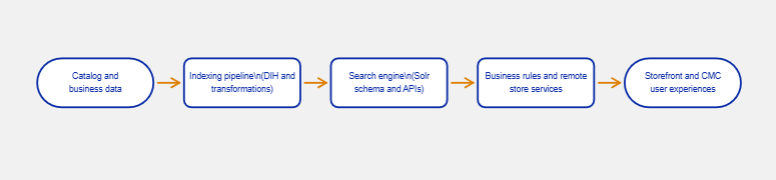
- Preserving legacy Solr and Elasticsearch behavior during migration to Commerce+ Transaction Server.
- Enabling PostgreSQL as an indexing data source.
- Removing IBM-specific runtime dependencies from remote store services.
Business Challenges and Solutions
| Business objective | Recommended capability | Operational task | Data flow logic |
|---|---|---|---|
| Migrate existing Commerce customers to Commerce+ Transaction Server without rebuilding search. | Deploy legacy Solr or Elasticsearch with Commerce+ Transaction Server. | Deploy legacy Solr or Elasticsearch components, preserve existing schema and V1 API compatibility, and validate storefront, CMC, marketing rules, role-based access control, and Ruby orchestration behavior. | The system carries the existing Solr and Elasticsearch setup forward into Commerce+ Transaction Server so you can migrate without redesigning search. |
| Move to PostgreSQL while keeping legacy search. | Support PostgreSQL with legacy Solr or Elasticsearch. | Update Data Import Handler (DIH) and transformation logic for PostgreSQL, validate indexing completeness, and confirm search behavior with PostgreSQL as the source database. | PostgreSQL becomes the indexing source without interrupting legacy Solr or Elasticsearch search behavior. |
| Remove IBM platform dependencies from search-related remote store services. | Remove IBM dependencies from Solr and Elasticsearch remote stores. | Identify IBM-specific dependencies, replace WebSphere Application Server components with Open Liberty, and validate deployment readiness. | Remote store services move to open runtime components while keeping search configurations intact. |
Prerequisites
Before you begin, verify that you have the following resources:
- Permission level
- Admin or implementation team access to Commerce+ Transaction Server, deployment configuration, and search environment settings
- System requirements
- Commerce+ Transaction Server environment with legacy Solr or Elasticsearch components, supported runtime dependencies, and database connectivity for Db2, Oracle, or PostgreSQL as applicable
- Data needed
- Existing product catalog, search schema or configuration, indexing inputs, and current search-related business rules such as marketing rules and rules-based sales categories
Technical details
- Deployment of legacy Solr and Elasticsearch infrastructure into Commerce+ Transaction Server.
- Compatibility of Solr and Elasticsearch schema and V1 search APIs with existing storefront and CMC behavior.
- Data Import Handler (
DIH) and transformation updates needed to support PostgreSQL. - Support for orchestration and service-layer connectivity between storefront, Ruby services, and the search engine.
- Removal of runtime dependencies specific to IBM from legacy CRS and transition to open standards (such as Open Liberty).
- Validation that indexing, metadata handling, extensibility points, and integration behavior remain stable after migration.