
CDM integration and Usage with Unica+ Products
Integration with MaxAI and CDP/External Systems:
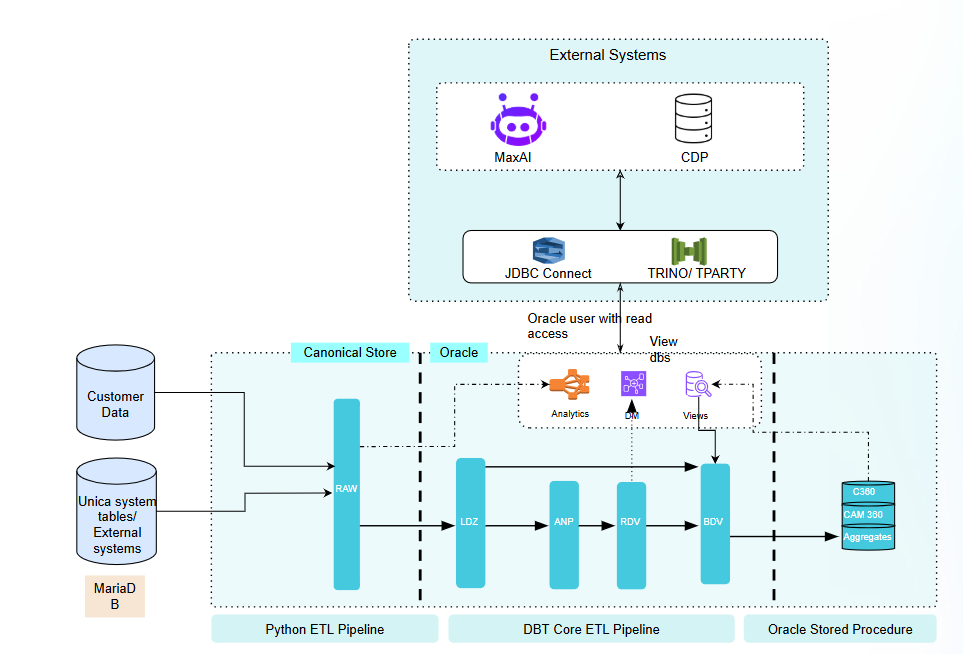
The Campaign subject area integrates with the Canonical Data Model through a metadata-driven pipeline that ingests source campaign data, transforms it to canonical Campaign entity structures, and exposes it downstream via Unica 360 Campaign 360.
Campaign Data Flow:
- Source Systems: Campaign data ingested from source systems (marketing automation platforms, campaign management systems)
- Landing Zone (LDZ): Raw campaign records staged in ldz_campaign_* tables preserving source structure
- Raw Data Vault (RDV): Campaign entities implemented as h_campaign (Hub), l_campaign_* (Links), and s_campaign_* (Satellites) following Data Vault 2.0 patterns
- Metadata-Driven Transformation: metadata model define source-to-canonical mappings for campaign attributes (campaign_id, campaign_name, campaign_type, campaign_status, budget, objective, target_audience)
- Campaign 360: Campaign 360 derives key performance metrics using pre-aggregated 360 tables and simple, standardized formulas applied to campaign-level contact and activity data. It provides a comprehensive, curated set of measures across audience size, engagement, responses, conversions, and cost attribution, enabling consistent evaluation of campaign effectiveness, ROI, and cross-channel behaviour.
Campaign Redbook Reference:
The Campaign Redbook serves as the authoritative documentation for campaign entity definitions, attributes, relationships, and transformation rules. It is maintained in parallel with the Metadata Model and provides business context for all campaign data.
- Entity Definition: Campaign Hub contains persistent campaign keys and core identifiers
- Relationships: Links capture campaign-party (targeting), campaign-offer (promotion assignments), campaign-channel (execution channels)
- Attributes: Satellites track campaign goals, budgets, performance metrics, status, and business metadata
- Reference Location: Campaign Redbook (for documentation reference and business context validation)
Customer Data Platform (CDP) Integration
The Canonical Data Model acts as the unified data backbone for the Customer Data Platform through 360 views. The CDP leverages both Customer 360 and Campaign 360 views to deliver comprehensive customer identity resolution, audience segmentation, and campaign orchestration capabilities.
- Identity Resolution: CDP receives unified customer profiles from Customer 360 with consolidated identifiers across channels (email, phone, mobile, web, social)
- Customer Attributes: Customer 360 aggregates unified customer identity, demographics, risk & compliance indicators, consent preferences, verified contact details, financial holdings, behavioral transaction metrics, multi-product engagement, campaign interactions (7D/30D), and conversion performance into a single consolidated customer profile.
- Relationship Hierarchies: Customer-to-account mappings for comprehensive view
- Real-time Updates: Metadata-driven CDC processes stream customer changes to CDP for real-time personalization
- Campaign Segmentation and Superset reports
- Performance Feedback: Campaign responses and outcomes feed back to Customer 360 for behavioral updates
- Ingestion: Customer source data (CRM, loyalty, transactional) ingested via LDZ
- Unification: RDV Hub-Link-Satellite structures implement Party and Relationship canonical entities
- Identity Resolution: Metadata-driven identity matching rules resolve customer IDs across sources
- Enrichment: Customer 360 adds calculated attributes (RFM, CLTV, engagement scoring)
- Activation: CDP reads Customer 360 and Campaign 360 to power segment definitions and campaign execution
MAX AI Integration: Intelligent Insights & Decisioning
MAXAI leverages 360 views (specifically Customer 360 and Campaign 360) to deliver AI-powered insights, advanced analytics, and intelligent segment recommendations. The integration transforms raw customer and campaign data into actionable intelligence. For more information, refer MaxAI Canonical Redbook.
- Leverages unified Customer 360 and Campaign 360 structures to generate high-quality analytical insights.
- Provides descriptive and diagnostic analytics across customer behavior, campaign performance, channel-level effectiveness, and offer details & Count at Campaign level.
- Highlights response patterns by customer attributes, and past campaign history.
- Enables cross-matching of customer behavior and campaign execution to detect correlations.
- Delivers natural-language answers to analytical questions through MAX AI (e.g., "Why did Campaign X underperform?"). This is only restricted to the Insights part of Max.
- Provides data value -volume insights by observing anomalies in Customer/Campaign 360 layers.
- Autonomous campaign optimization loops, learning from historical outcomes to propose targeting and offer strategy.
- Unified 360 Expansion: Extend Customer 360 and Campaign 360 with Offer 360, Journey 360, Interact 360, Event 360, and Channel 360 to create a full-spectrum marketing knowledge graph.
- Works on reports, charts, and campaign metrics within Unica.
- Interprets KPIs, graphs, and dashboards to generate human-readable insights (e.g., “Conversions increased 15% last week due to SMS channel performance”).
- Supports follow-up conversational queries for deeper exploration.
- Helps marketers make data-driven decisions without needing SQL or analytics expertise.
Canonical-to- 360-to-MAX AI Data Flow:
- Canonical Data Model Standardizes Inputs: Customer, account, product, transaction, offer, and campaign data from all source systems are harmonized into a unified, normalized structure.
- Feature-Ready Integration: Canonical entities carry consistent business keys and relationship maps, enabling deterministic links across customer, campaign, and interaction domains.
- Customer 360 Construction: Canonical records are aggregated into a longitudinal, behavior-rich customer profile including demographics, preferences, lifecycle stage, interactions, and responses.
- Campaign 360 Construction: Canonical campaign, offer, treatment, and contact history data are assembled into complete campaign lifecycle views, including performance metrics and historical flowchart patterns.
- Cross-Domain Joining: Customer 360 and Campaign 360 are fused to provide full visibility into how each customer behaves across every campaign touchpoint.
- Analytical Layer Preparation: Aggregations, time-series transformations, feature windows, and derived KPIs are created to power insights and machine-learning readiness.
- MAX AI Insight Engine: MAX AI consumes 360-layer datasets to answer analytical questions, detect patterns, surface drivers of performance, and highlight opportunities.
- AI-Ready Metadata Exposure: Canonical and 360 structures expose standardized attributes, entities, and lineage, enabling MAX AI to interpret intent and retrieve accurate insights.
- Foundation for Predictive Automation: The flow establishes a reliable, governed data fabric that future MAX AI models will use for segmentation automation, propensity scoring, and campaign optimization.
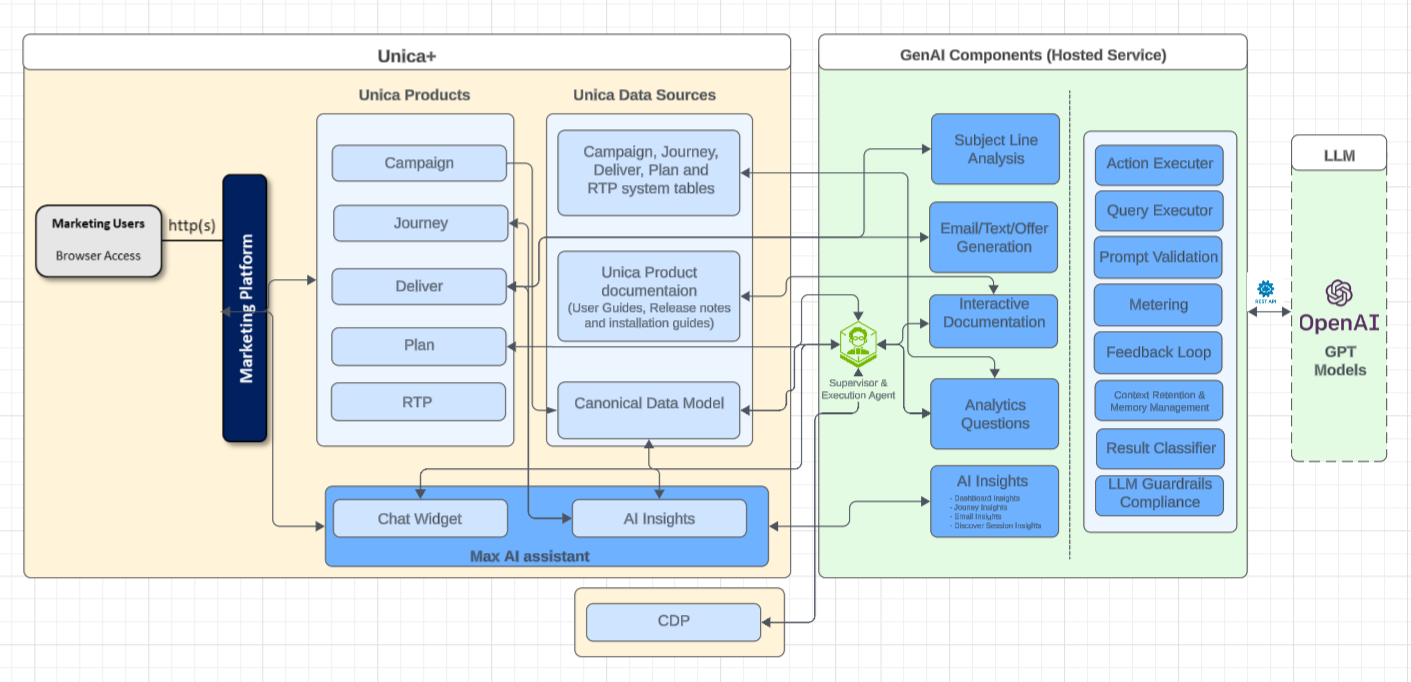
Integrated Architecture: Canonical Model as Enterprise Data Backbone
The following diagram illustrates how the Canonical Data Model, through 360 views, serves as the unified data backbone for Campaign, CDP, and MAX AI systems:
| Integration Point | Primary Unica 360 Views | Key Capabilities | Reference Documentation |
|---|---|---|---|
| Campaign | Campaign 360 | Campaign goal tracking, budget management, performance metrics, multi-channel execution | Campaign Redbook |
| Customer Data Platform (CDP) |
Customer 360 Campaign 360 |
Identity resolution, audience segmentation, segment activation, campaign orchestration | CDP Integration Guide (Master Interface Document) |
| MAX AI |
Customer 360 Campaign 360 |
Analytical insights, Cross domain analytics, intelligent segment discovery and refinement | MAX AI Implementation Guide |
| Metadata Model (CORE) | All 360 Views | Integration orchestration, transformation rules, data quality, lineage tracking | Metadatamodel.ddl |
Integration Conclusion
The Canonical Data Model, implemented through the three-layer architecture (LDZ, RDV, Unica 360) and orchestrated by the Metadata Model, provides a unified, extensible foundation for enterprise customer data management. By integrating Campaign, CDP, and MAX AI systems, organizations achieve:
- Rapid Integration: Metadata-driven architecture enables new integrations without code proliferation
- End-to-End Lineage: Complete tracking from source through transformation to activation
- Intelligent Automation: MAX AI leverages unified data for insights, validation, and segment recommendations
- Scalable Growth: New subject areas and integrations onboard via metadata configuration
- Compliance & Governance: Centralized data quality, lineage, and audit trails for regulatory requirements