
Canonical Model Architecture: Three-Layer Implementation with Metadata as Core
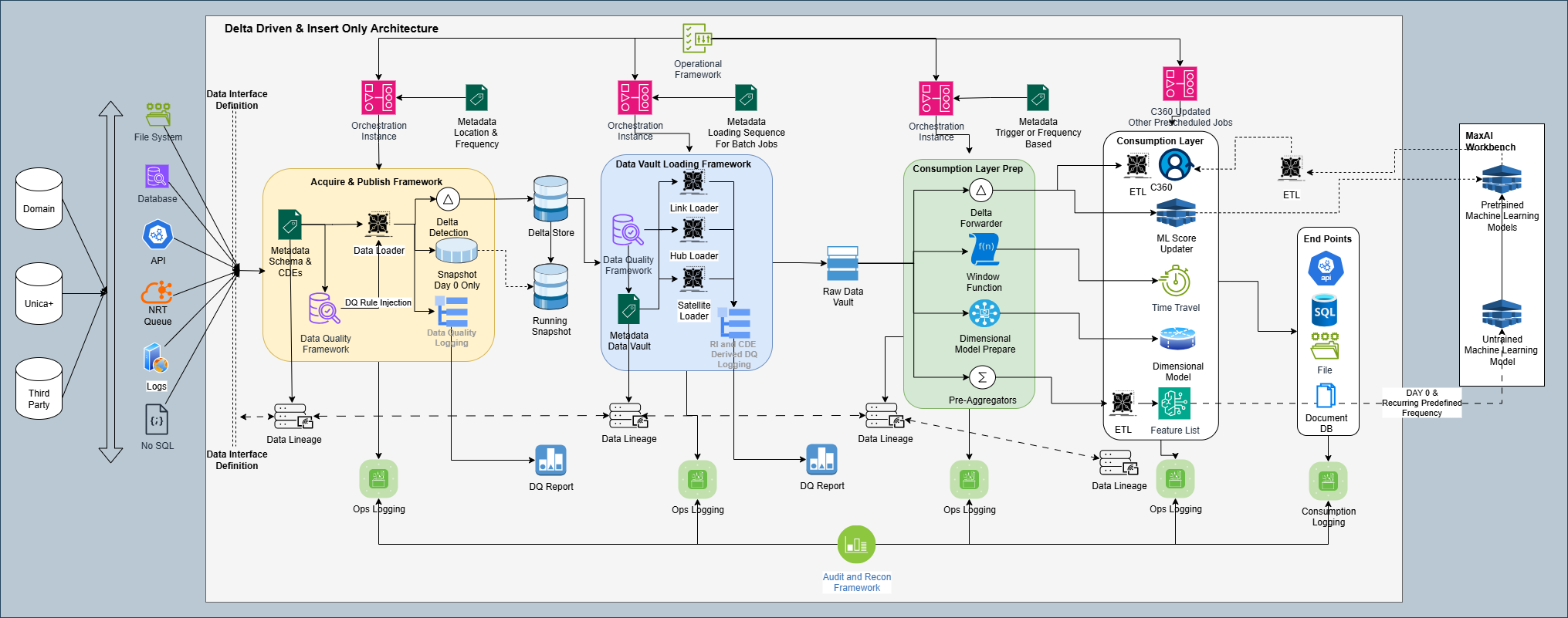
The Canonical Model is implemented across three distinct layers, each serving a specific purpose in the data pipeline. However, the Metadata Model is the CORE that drives integration, ETL automation, data quality, and lineage across all three layers.
Key benefits of Canonical Architecture:
- Metadata-Driven Evolution: New attributes, entities, or relationships can be added without changing physical schemas. The Metadata Model drives all changes, enabling dynamic schema evolution across the three-layer architecture. Each entity, attribute, and relationship is defined in metadata tables, enabling dynamic schema evolution
- Multi-layer implementation: Deployed across Landing Zone (LDZ), RAW Data Vault (RDV), and integrated with CDM through a metadata-driven core
The Three-Layer Architecture
Layer 1: Landing Zone (LDZ) -- Staging Layer
The Landing Zone is the first ingestion point for raw data from source systems. It captures data in its original form with minimal transformation, serving as the foundation for CDC (Change Data Capture) tracking.
- Schema: dev_ldz (or prod_ldz, test_ldz depending on environment)
- Stores raw data exactly as received from source systems
- Minimal data transformation (only source-specific format parsing)
- Preserves business keys for tracking and reconciliation
Layer 2: RAW Data Vault (RDV) -- Data Vault 2.0 Layer
The RDV transforms landing zone data into Data Vault 2.0 structures (Hubs, Links, Satellites, Link-Satellites ). This layer implements the canonical model in its physical form and is the persistent store for all business entities and relationships.
- Schema: RAW Data Vault schema (typically dev_rdv, prod_rdv, etc.)
- Implements Data Vault 2.0 principles for scalability and auditability
- Central repository for all canonical entities evolving across subject areas
Layer 3: Unica 360 -- Customer Experience Intelligence Layer
Unica 360 provides unified customer intelligence through domain-specific 360-degree views. This layer transforms RDV data into business-ready insights, enabling precise, contextual, and personalized customer experiences.
- Customer 360: Identity, CLTV, RFM scores, lead scores per customer
- Campaign 360: Campaign goals, budget, state, performance metrics
- Offer 360: Future release- Offer eligibility, progression paths, performance tracking
- Channel 360: Future release- Channel preferences, fatigue management, Next Best Channel
- Journey 360: Future release- Customer journey state machines, path analytics
- Product 360: Future release- Product upgrade paths, affinity scores, recommendations
- Response 360: Future release- Customer responses (opens, clicks, redemptions)
- Attribution 360: Future release- Multi-touch attribution models, channel effectiveness