
HCL CDP Architecture
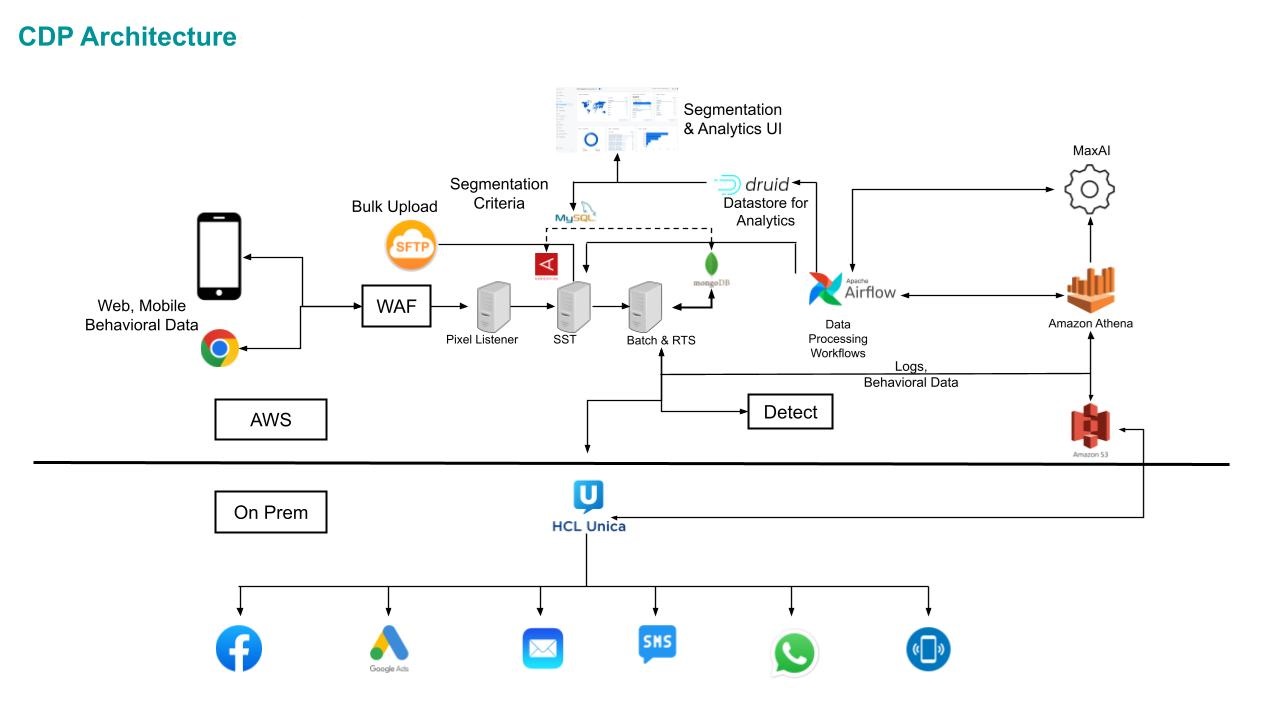
HCL CDP is intended to gather, process, and analyze behavioral data from web and mobile platforms for marketing purposes. It integrates various systems to collect user data, which is then processed for segmentation, enabling the delivery of targeted marketing campaigns through multiple marketing channels. The subsequent sections outline the essential components and their interactions in a streamlined flow.
Data Collection and Security
The process initiates with the gathering of behavioral data from web browsers and mobile applications. Each user interaction on a website or mobile app, including clicks and navigation, is recorded by a pixel tracking system. Before the data is stored or processed, it is filtered through a security mechanism referred to as a Web Application Firewall (WAF). This firewall ensures the safety of all incoming data, effectively mitigating potential security threats and unauthorized access to the system. This data can also be uploaded in bulk via secure channels such as SFTP.
Data Storage and Real-Time Processing
Once the data has been securely gathered, it is transmitted to the system's core, referred to as the Single Source of Truth (SST). This central component guarantees that all information regarding a user, whether sourced from the web or a mobile application, is stored consistently, thereby offering a cohesive perspective on each user's behavior.
The Batch/Realtime Segmentation Engine, backed by MongoDB, processes this data by applying segmentation criteria. These rules determine user grouping based on behavior, enabling dynamic creation of audience segments. The segmentation criteria are defined through a user interface that interacts with underlying MySQL-based configurations.
Data Processing and Orchestration
Data requires processing and transformation for a variety of applications, including analytics and reporting. This is where the orchestration platform, Apache Airflow, plays a crucial role. Apache Airflow orchestrates the data pipelines and workflows, handling tasks such as log processing, data enrichment, and transformation. Processed logs and behavioral data are stored in Amazon S3, which serves as a central repository.
Using Amazon Athena, the system performs complex querying on large-scale datasets stored in S3. Additionally, insights and processed data are used to train and operate MaxAI Workbench models, enhancing personalization and targeting capabilities.
For analytics and segmentation UI, the platform utilizes Druid for real-time data querying and analytics.
User Interface and Analytics
The system presents all collected and processed data to end users via an intuitive interface. This segmentation and analytics user interface allows marketers to examine the data, formulate new segmentation rules, or modify existing ones according to their organizational requirements. Through this interface, users can effortlessly monitor user activity, comprehend behavioral patterns, and establish new criteria for user segmentation. This interface interacts with MySQL and Druid to offer real-time insights, supporting campaign planning and performance analysis.
Marketing Automation and Campaign Execution
Once users are segmented according to their behavior, the system initiates marketing campaigns aimed at effectively reaching these segments. The marketing automation tool, HCL Unica, interfaces directly with the segmented data, guaranteeing that tailored marketing messages are dispatched to the appropriate users at optimal times. It executes campaigns across a variety of channels such as Facebook, Google Ads, email, SMS, WhatsApp, and voice call platforms. Campaigns are initiated based on detected user segments and their behavior patterns, ensuring relevant and timely communication. A detection mechanism also supports real-time campaign triggers based on specific user events or criteria.
Integration with External Systems
The system seamlessly integrates with external data sources and marketing channels. For example, data can be transferred in bulk through secure file transfer protocols (SFTP) for subsequent analysis. In addition, integrations with prominent advertising platforms such as Facebook Ads and Google Ads ensures optimizing marketing initiatives across various channels. This capability allows for a comprehensive strategy that utilizes both web and app user data for cross-channel marketing campaigns.
The updated architecture also supports both cloud-native (AWS) and on-premise deployments, enhancing flexibility and scalability.