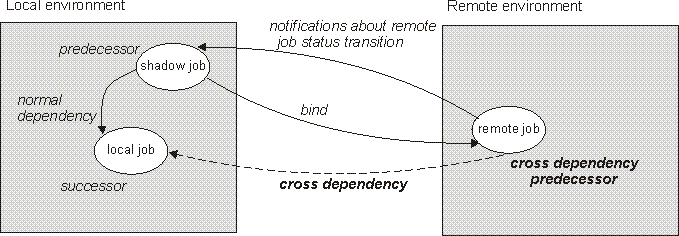
The following objects and terms are used to describe and implement
cross dependencies:
Remote engine workstation
A type of workstation that
represents locally a remote HCL Workload Automation engine, either distributed, z/OS, or
HCL Universal Orchestrator. This type of workstation uses a connection based on HTTP or HTTPS protocol to
enable the local environment to communicate with the remote environment.
Remote job
A job scheduled to run on a remote HCL Workload Automation or HCL Universal Orchestrator engine.
Shadow job
A job defined locally,
on a remote engine workstation, which is used to map a remote job.
The shadow job definition contains all the information necessary to
correctly match, in the remote engine plan, the remote job instance.
Bind
The
process to associate, in the remote engine plan, a shadow job with
a remote job instance.
From a logical point of view in the local environment:
The remote engine workstation is used to map the remote HCL Workload Automation engine.
The shadow job, defined on that remote engine workstation, is
used to map a remote job instance scheduled to run on that remote HCL Workload Automation engine.
To implement a cross dependency, you must define a normal dependency
for your local job on a shadow job that:
Points to the remote job on which you want to create the cross
dependency.
Is defined locally on the remote engine workstation that points
to the engine where the remote job is scheduled to run.
In the bind process, the shadow job is associated to the remote job instance.
After the bind is established, the shadow job status is updated according to the remote
job status transition.
When the shadow job status becomes COMPLETE (C) the normal dependency of the local job
is released, and so also the cross dependency of that local job on the remote job is also
released.
Figure 1. Cross dependency logic
For a description of the steps to define a cross dependency between a job defined in your
environment and another job defined on a remote engine, see the following sections: