The SEQQWAPL library has DATE members containing public
holidays for some countries; you can use them to create variables
containing dates for public holidays. For countries without DATE members,
use VARDATE to create your own rules for public holidays.
The following example shows a sample job for creating public holidays
in the calendar for the forthcoming year (CALNL).
The flat file will contain all the dates contained within the calendar,
for as many years as the calendar covers. You can use it with the
EQQWXHTM WAPLEXEC to extract specific years and produce the HTML versions.
Because the input file contains dates for 2 years, you can run 2 steps
which can each concentrate on an individual year by use of the YEAR keyword.
The following example shows a sample job for exporting calendar
dates into a flat file (CALUNLD).
//EXP2012  EXEC EQQYXJPX,
//         ARGS='YEAR(2012)',
//         CMD=EQQWXHTM,
//         SUBSYS=WSJC
//OUTHTML  DD DISP=SHR,DSN=ADCDMST.CZ.JCL(CAL2012)
//CLSDDATE DD DISP=SHR,DSN=ADCDMST.CZ.JCL(CALDATES)
//SYSIN    DD *
DAYS(M D W D V Z Z)
MONTHS(JANUARI FEBRUARI MAART APRIL MEI JUNI
       JULI AUGUSTUS SEPTEMBER OKTOBER NOVEMBER DECEMBER)
PROCESS(CLSDDATE) HILITE(gray-yellow)
/*
//EXP2013  EXEC EQQYXJPX,
//         ARGS='YEAR(2013)',
//         CMD=EQQWXHTM,
//         SUBSYS=WSJC
//OUTHTML  DD DISP=SHR,DSN=ADCDMST.CZ.JCL(CAL2013)
//CLSDDATE DD DISP=SHR,DSN=ADCDMST.CZ.JCL(CALDATES)
//SYSIN    DD *
DAYS(M D W D V Z Z)
MONTHS(JANUARI FEBRUARI MAART APRIL MEI JUNI
       JULI AUGUSTUS SEPTEMBER OKTOBER NOVEMBER DECEMBER)
PROCESS(CLSDDATE) HILITE(gray-yellow)
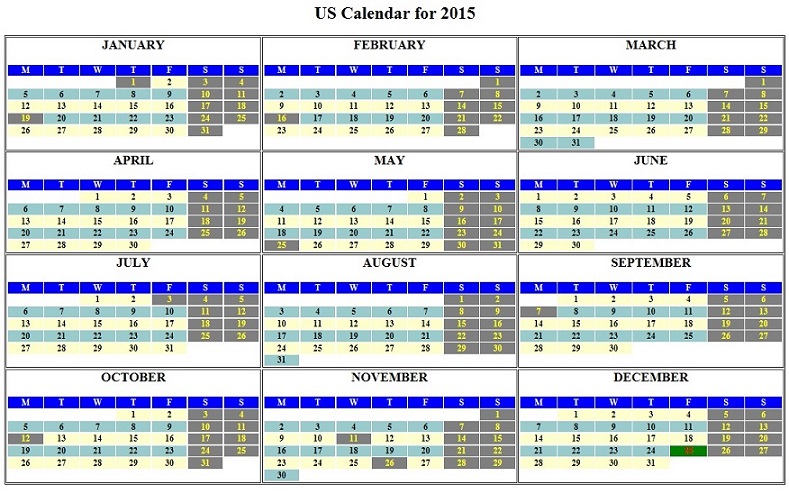
You can then send the output file to review the dates for the forthcoming
year, or simply use it as a reference to view the free days.Figure 1. US
calendar for 2015