Clara runs actions on your behalf
At Clara startup, or when you enter the "What can you do?" conversation flow, you can view the smart cards representing the categories of actions that Clara can run on your behalf.
Notes:
Not all of Clara actions are available with the first release of HCL Universal Orchestrator. If you select an action that is not yet available, Clara will inform you with a message.
-
Managing your workload - You (as an operator) can submit a job or modify a job execution by running the following actions:
-
Rerun a job - to rerun a job that is in error status (available for WAd only).
-
Submit a job - to submit a predefined job (available for WAd only). For details, see Submit a job.
-
Submit a job stream - to submit a predefined job stream for processing (available for WAd and WAz).
-
Cancel a job - to cancel a job before it is launched (available for WAd only).
-
Release a job - to release a job from dependencies (available for WAd and WAz).
-
Hold a job - to put a job in HELD status, awaiting for dependencies resolution (available for WAd and WAz).
-
Change the priority of a job - to change the order of running of a job (available for WAd only).
-
Release all dependencies of a job - (available for WAd only).
-
Change the limit of a workstation - to change the maximum number of jobs running concurrently on that workstation (available for WAd only).
-
Link a workstation - (available for WAd only).
-
-
Monitoring and environment info - You (as an administrator) can get information about scheduled jobs by running the following actions:
-
Get the log of a job - to view the log of a job and download it.
-
Get the status of a job - to retrieve information about the current status of a job. For the completed jobs, you can get the job log or rerun them if completed with errors (available for WAd and WAz).
-
Monitor a job - to monitor a job and receive a notification when the job status changes (available for WAd only). For details, see Monitor a job.
-
Get the overall status of the current plan - to retrieve information about the status of all the jobs in the current plan (available for WAd and WAz). For details, see Get the status of the current plan.
-
Get the status of a workstation - to search for a workstation and see its status.
-
Get the WA version/release in your environment - retrieve information about the current version or release of Workload Automation installed in your environment (for WAz, the information retrieved are related to the Dynamic Workload Console).
-
-
Self-Service Catalog - You (as an operator or administrator) can manage the workload in the Self-Service Catalog by running the following action:
-
Submit a service from the catalog - (available for WAd and WAz). For details, see Submit a service from Self-service Catalog.
-
-
Troubleshooting - You (as an operator or administrator) can speed up the Workload Automation troubleshooting. For details, see Clara helps in problem determination. Actions you can run are:
-
Why a job is not starting - You can understand why a job is not starting (available for WA only).
-
Get the jobs in error in the current plan - You can find any jobs in error in the daily plan (available for WAd and WAz).
-
Get the critical jobs in the current plan - You can find any jobs in late in the daily plan (available for WAd and WAz).
-
-
Monitoring with HERO - You (as an administrator) can monitor and get information about your Workload Automation servers through HERO. For details, see Clara monitors your server through HERO. Actions you can run are:
-
Get the overall status of PROD servers - to monitor and get information about your WA production servers through HERO (available for WA only).
-
Are there any issues with my servers? - to quickly discover if there are any issues (errors or warnings) with your production and non production servers.
-
Monitor a server - you can ask Clara to monitor a specific server and send you a notification when the server status changes.
-
Notes: For details about how to search for a job when running one of the above action, see Searching for a job.
When you run an action, Clara leverages the authentication mechanism of Workload Automation. If a user is not authorized to run an action in Workload Automation, Clara returns an error.
Searching for a job
For all the actions dealing with jobs, such as Submit a job or Monitor a job, when you start the action, the conversation flow to identify the job is as follows:
-
Clara asks for the job name and shows the list of all jobs in the current Workload Automation environment.
-
Select a job from the list or, if you remember the job name (full or partial), type it in the input field. You can filter the job names in different ways:
-
By using the "*" wildcard anywhere in your search string. You can use more than one "*" wildcard in your search string.
-
By typing the name (full or partial) of the workstation where the job has been defined.
-
By typing the name of the job stream (full or partial) that contains the job.
-
By typing the name of the folder. For example, type /folder_name/* to get all jobs in the folder_name folder.
-
Filters can be combined all together.
Otherwise, click one of the following tips:
-
Cancel - to cancel the action
-
Search by name - to search the job by providing the name (full or partial) of:
-
The job itself.
-
The workstation where the job has been defined.
-
The job stream that contains the job.
-
The folder.
-
-
Search by folder - to search the job by folder name. If you know the folder name, type /folder_name/* in the input field to get all jobs in the folder_name folder.
-
Show me more jobs button to see more jobs.
The process of searching for an object is technically called entity recognition process. In Clara, it is based on data extraction and caching of the information related to your Workload Automation environment. In this way, Clara is always aware of the conversation context and can easily identify the names of jobs, job streams and workstations at any moment, making the conversation faster and smarter.
Submit a job
This action is available for WAd type environments only.
To submit a job with Clara, run the following steps:
-
Among the actions Clara can help you with, select Managing your workload > Submit a job.
-
Identify the job to submit by following the Searching for a job conversation flow.
-
Clara asks for the job alias. Click the tip No alias if you don't want to set a job alias.
-
Clara asks for the job stream and shows a list of job streams for submitting the job.
-
Type a job stream name or select one from the list. You can filter the job stream names by using the "*" wildcard anywhere in your search string.
-
Clara asks for the workstation name and shows the list of the workstations in the current Workload Automation environment.
-
Type a workstation name or select one from the list. You can filter the workstation names by using the "*" wildcard anywhere in your search string.
-
Clara asks for a confirmation about the action on the selected job.
-
Click Yes to confirm.
Some steps of the above conversation might be skipped by Clara if, based on the entity recognition process, she is already aware of the job stream or workstation name.
At each step of the conversation flow, Clara provides the tip Search by name. By selecting this tip, Clara allows you to search for a job stream or a workstation by providing the full or partial name. You can filter the search result by using the "*" wildcard anywhere in your search string.
For an even quicker interaction, you can type your entire command in the input field. For example:
Submit job job_name in job_stream_name on workstation_name with alias alias.
Monitor a job
Clara can monitor a job and send you notifications when the job status changes.
To receive Clara notifications, you must first enable notifications in your browser. For details, see: How to enable persistent notifications. If you skip this step, Clara warns you with a message and provides a button to enable the notifications.
To monitor a job and receive Clara notifications, run the following steps:
-
Among the actions Clara can help you with, select Monitoring and environment info > Monitor a job.
-
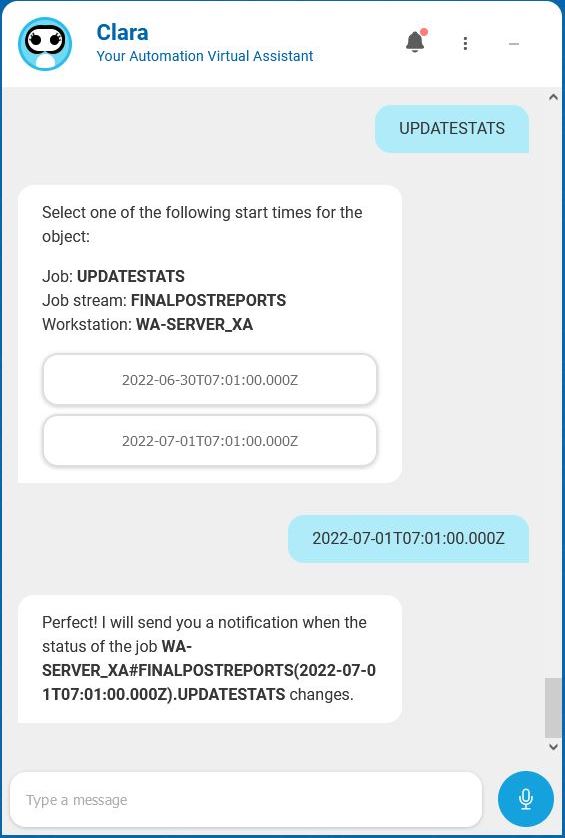
When required by Clara, provide the job name, the job stream name, and the workstation name for the job you want to monitor. For details, see Searching for a job.
-
Clara starts monitoring the job. She checks the job status at time intervals depending on the estimated duration of the job, and notifies every status change.
-
A red dot appears on the bell on the chat header meaning that you have unread notifications. An e-mail with the new job status is also sent to the e-mail address you have specified during the Add User flow, on the Credential Manager user interface.
-
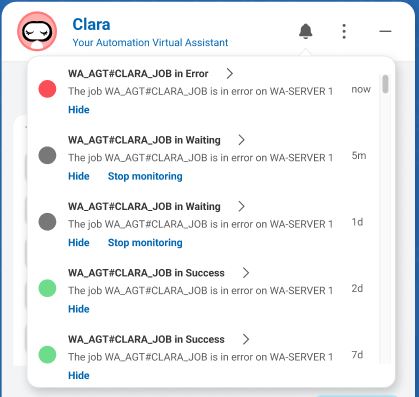
To view the notification messages, click the bell. A panel appears, showing the notification queue. A maximum number of 10 notifications is kept for a week.
-
For each notification, you can run the following actions:
- Hide - to hide the notification.
- Stop monitoring (only for jobs not yet completed) - to stop monitoring the job.
-
By clicking on each notification, you can get the timestamp of when the status change occurred.
Get the status of the current plan
As a Workload Automation administrator, you might need to check the status of the current plan. Run the following steps:
-
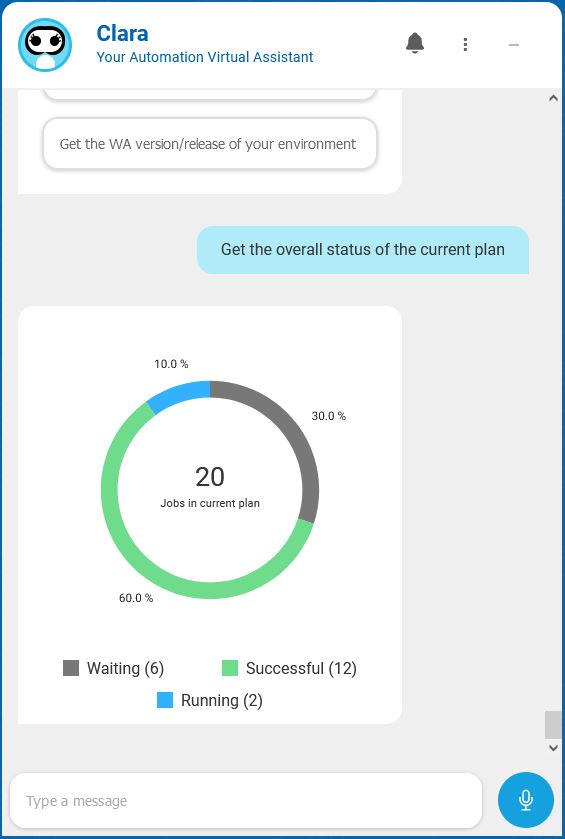
Among the actions Clara can help you with, select Monitoring and environment info > Get the overall status of the current plan
-
Clara provides an interactive segmented donut chart where each color corresponds to a job status. By clicking each segment of the chart, you get the number of jobs in that specific status.
Submit a service from Self-Service Catalog
From V2.0.0.2, Clara supports the new Self-Service Catalog introduced by HCL Workload Automation V10.1 fix pack 1. For details about the new Self-Service Catalog and its prerequisites, see HCL Workload Automation documentation.
Ensure you have access to the Self-Service Catalog, otherwise contact WA administrator.
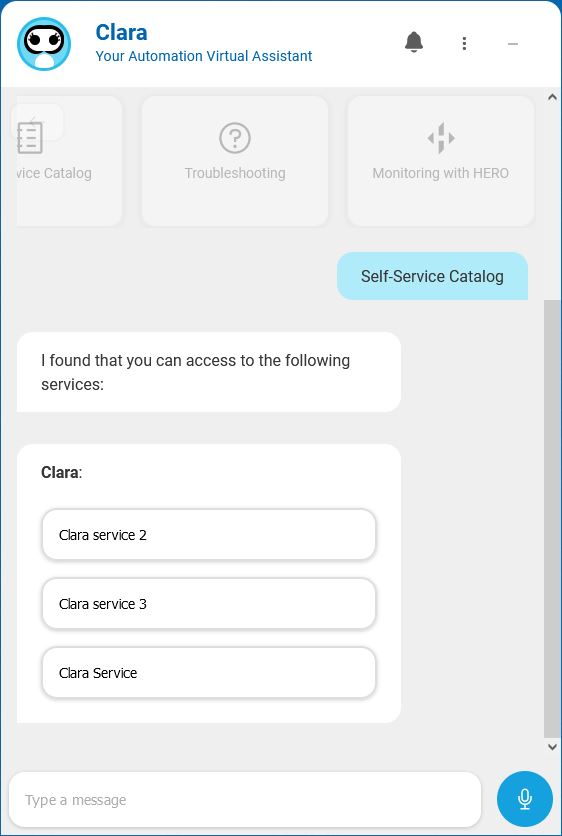
When you select the Self-Service Catalog action, Clara shows all the services available in the Self-Service Catalog. If you have both new and old Self-Service Catalogs coexisting in your Workload Automation environment, Clara will show the available services all together in the same way, without specifying the catalog name.
If a message appears saying that no services were found, see these troubleshooting hints.
-
Select the service that you want to submit.
-
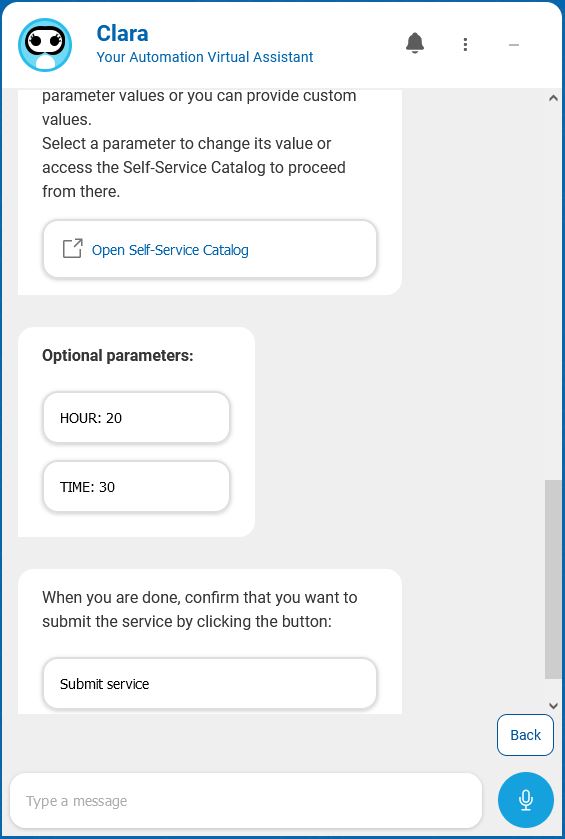
Mandatory and optional parameters are displayed by Clara with default values, if any.
-
You can submit the service with default parameter values or you can provide your custom values. Select a parameter to set or change its value. A link to Self-Service Catalog is provided if you want to modify the parameters and submit the service from there.
-
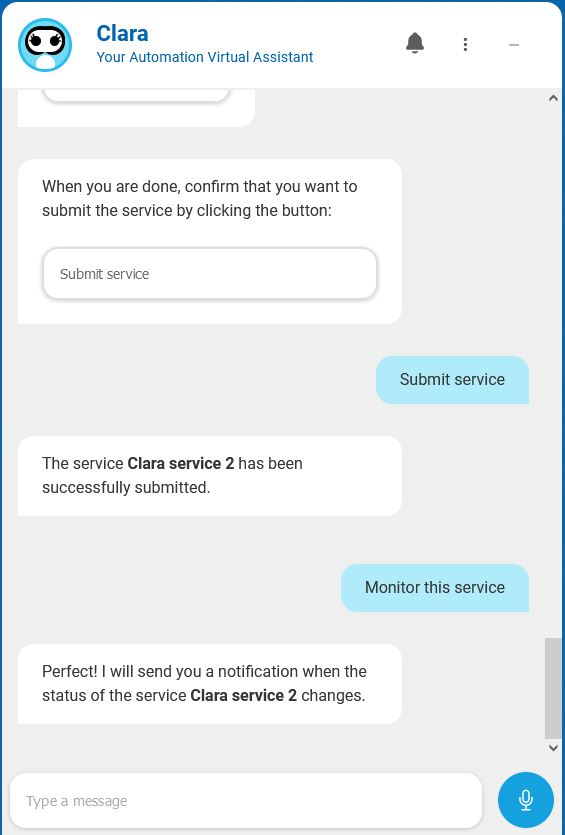
Click Submit service.
-
Click the suggested action Monitor this service to ask Clara to monitor the service execution for you and send a notification when the service status changes.
Note: Remember to enable Clara to send notifications. If you don't enable notifications when opening Clara UI, Clara will assist you to enable notifications in your browser later on.
-
Clara will notify you when the status of your submitted service changes into:
-
Started
-
Completed successfully
-
Completed with errors
-
Error
-
In late
-