As with traditional Web services, RESTful Web services are created
from ZIETrans Integration Objects and their input and output properties.
With traditional Web services, you define the location and input and
output properties of the Web service resources in a WSDL file. However,
with RESTful Web services, you define access to the Web service
resources using URIs to represent the resources, HTTP methods to operate
on the resources, and HTTP header information to define the message
formats.
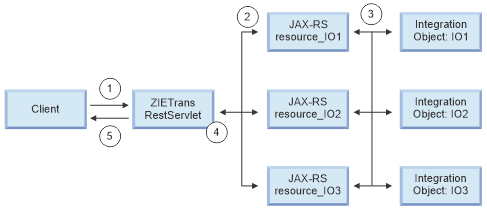
In the following figure is an architectural view of ZIETrans support
for RESTful Web services.
The ZIETrans RestServlet receives from a client an HTTP request with
URI and an HTTP method.
The RestServlet routes the request by mapping information in the
URI and the HTTP method to a JAX-RS resource for an Integration
Object.
The JAX-RS resource receives the request, reads the parameters
in the request, initializes the Integration Object, sets prompts (input
properties), and runs the Integration Object.
The JAX-RS resource receives extracts (output properties)
from the Integration Object, generates a response, and returns it
to the RestServlet.
The RestServlet responds to the client.
Figure 1. ZIETrans RESTful Web service architecture
Note: To run a ZIETrans Integration Object, the client must call
one Integration Object at a time. For chained Integration Objects,
the client must call one Integration Object, then call the next, passing
the link key, or you must modify the wrapper to call one Integration
Object after another, passing the link key.
ZIETrans provides tools you can use to create JAX-RS resources
for your Integration Objects, and mappings so that URIs and HTTP methods
in HTTP requests can be mapped to the correct JAX-RS resources.