
modules and the database server
This section describes the overall architecture of the HCL Informix® database server, how modules affect database server processes, and the application programming interfaces you can use in your modules and client applications.
The following figure illustrates the following components of the Informix® database
server architecture when it includes modules:
- modules, which extend the capabilities of the database server
- module application programming interfaces, which allow modules access to data stored in a database
- The database server, which includes virtual processors that your Informix® database server uses to process tasks, the shared memory that these virtual processors use, and the Java™ virtual machine to process routines written in Java™
- The HCL Informix® Client Software Development Kit, which includes client-side APIs that enable you to write client applications that access data stored in a database
- module ActiveX and Java™ value objects, which enable you to provide client-side interfaces to extended data types and their support routines
- Client visualization tools, which enable you to view and manipulate data retrieved from modules with third-party applications
- Client applications, which allow the user access to module
functions and data stored in a database
Figure 1. HCL Informix® with modules 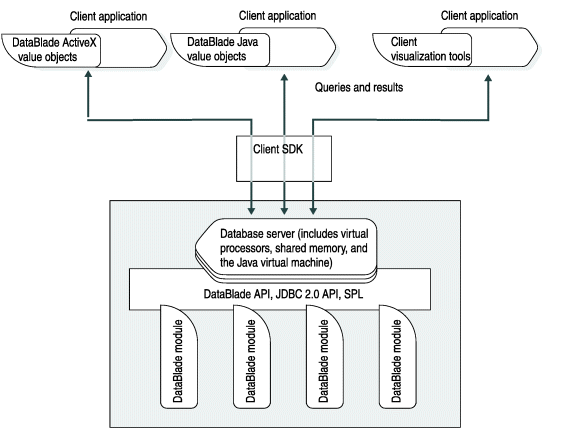
The close integration of modules
with the database server means that the database server treats new,
extended data types in the same way that it treats its own built-in
data types.
Important: You must use the option
of HCL Informix® to
enable services that use Java™.
For more information about ,
see the HCL®
J/Foundation Developer's Guide.