The database server uses an arbitrary rule to define nonoverlapping
fragments based on multiple columns.
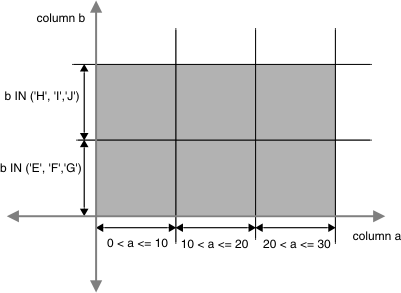
The following figures show an example of nonoverlapping fragments
on two columns. Figure 1. Example of nonoverlapping fragments on two columns
...
FRAGMENT BY EXPRESSION
0<a AND a<=10 AND b IN ('E', 'F', 'G') IN dbsp1,
0<a AND a<=10 AND b IN ('H', 'I', 'J') IN dbsp2,
10<a AND a<=20 AND b IN ('E', 'F', 'G') IN dbsp3,
10<a AND a<=20 AND b IN ('H', 'I', 'J') IN dbsp4,
20<a AND a<=30 AND b IN ('E', 'F', 'G') IN dbsp5,
20<a AND a<=30 AND b IN ('H', 'I', 'J') IN dbsp6;
Figure 2. Schematic example of nonoverlapping fragments on two columns
If you use this type of distribution scheme, the database server
can eliminate fragments on an equality search but not a range search.
This capability can still be useful because all INSERT operations
and many UPDATE operations perform equality searches. Avoid using
a REMAINDER clause in the expression. If you use a REMAINDER clause,
the database server cannot always eliminate the remainder fragment.
This alternative is acceptable if you cannot obtain sufficient
granularity using an expression based on a single column.