The external representation of an opaque data type is a
character string. This string is the literal value for
the opaque-type data.
A literal value can appear in SQL statements most anywhere that
the binary value can appear. For your opaque-type data to be valid
as a literal value in SQL statements, you must define its external
representation. It is important that the external representation be
reasonably intuitive and easy to enter.
Tip: The external
representation of an opaque data type is its ASCII representation.
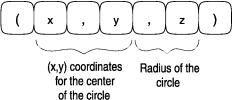
Suppose you need to create an opaque type that holds information
about a circle. You can create the external representation that the
following figure shows for this circle. Figure 1. External representation of the circle opaque
data type
INSERT INTO tab1 (id_col, circle_col) VALUES (1, "(2, 3, 9)");
Similarly, when an opaque type has an external representation,
a client application such as (which displays results as character
data) can display a retrieved opaque-type value as part of the output
of the following query:
SELECT circle_col FROM tab1 WHERE id_col = 1;
In , the results of this query would display as follows:
(2, 3, 9)
Tip: The external representation of an opaque data type is handled
by its input and output support functions. For more information, see The input and output support functions.