You insert an element into an open collection with the mi_collection_insert() function.
You can perform an insert operation only on a read/write cursor. An
insert is not valid on a read-only cursor.
The mi_collection_insert() function uses an MI_DATUM value
to represent an element that it inserts into a collection. The contents
of the MI_DATUM structure depend on the passing mechanism that
the function used, as follows:
In a C user-defined routine (UDR), when mi_collection_insert() inserts
an element value, it can pass the value by reference or by value,
depending on the data type of the column value. If the function passes
the element value by value, the MI_DATUM structure contains
the value. If the function passes the element value by reference,
the MI_DATUM structure contains a pointer to the value.
In a client LIBMI application, when mi_collection_insert() inserts
an element value, it always passes the value in an MI_DATUM structure
by reference. Even for values that you can pass by value in a C UDR
(such as an INTEGER values), this function passes the element value
by reference. The MI_DATUM structure contains a pointer to
the value.
The mi_collection_insert() function inserts
the new element at the location in the collection cursor that its action argument
specifies. For a list of valid cursor-action flags, see Valid cursor-action
constants.
Server only: The following call to mi_collection_insert() can
pass in an actual value because it inserts an INTEGER element into
a LIST collection and integer values are passed by value in a C UDR:
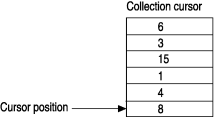
The following figure shows the cursor position after the preceding
calls to mi_collection_insert() complete.Figure 1. Collection cursor after
inserts complete
These mi_collection_insert() calls specify absolute
addressing (MI_CURSOR_ABSOLUTE) for the collection because the collection
is defined as a LIST. Only LIST collections have ordered position
assigned to their elements. SET and MULTISET collections do not have
ordered position of elements.