This section provides a short tour of basic product features and procedures, including using the wizard to set up a scan.
Describes the components of the AppScan main screen (Issues view), and all menus and toolbars.
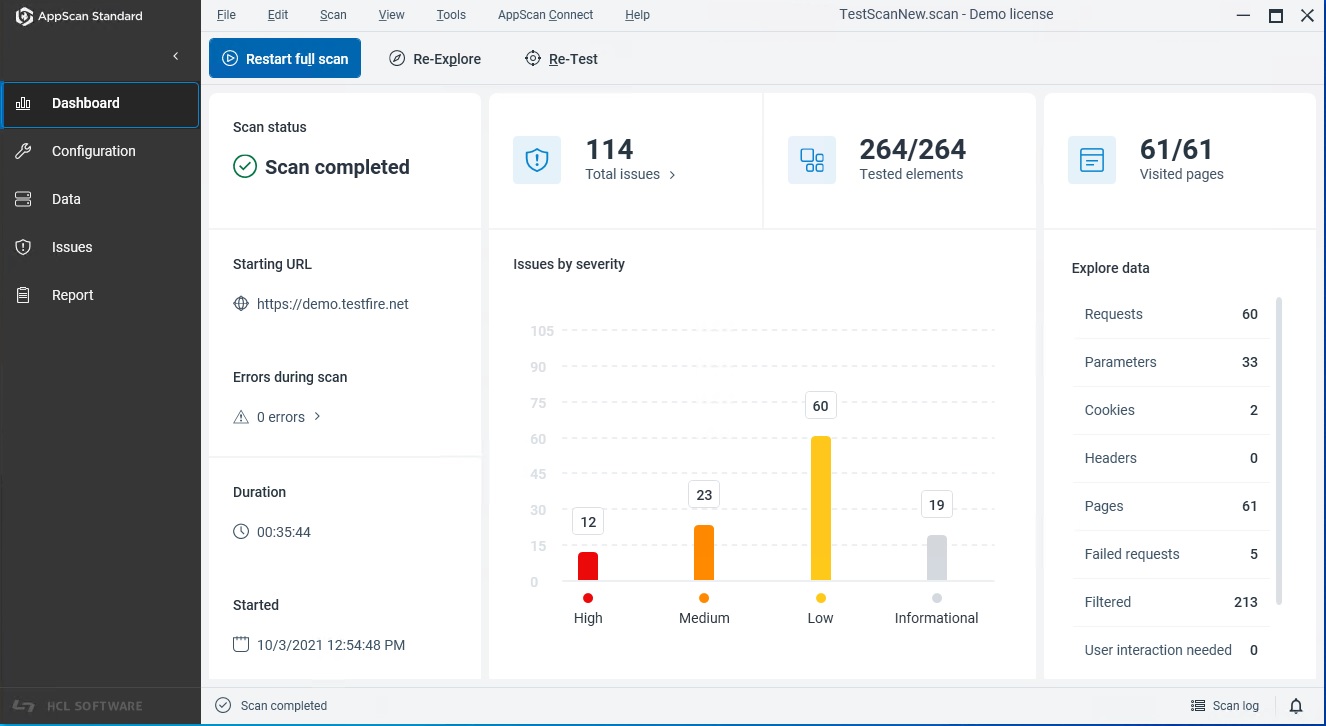
The dashboard shows a summary of the scan's configuration, status, data and results.
Welcome to the documentation for HCL AppScan Standard version 10.10.0
This section outlines the latest features, enhancements, fixes, important upcoming changes as well as deprecations across recent versions of AppScan Standard. Stay informed about the advancements that help you maintain a strong security posture.
A summary of the minimum hardware and software required for the machine that runs AppScan Standard.
The installation wizard guides you through the fast and simple process.
HCL manages software downloads and licensing through the My HCLSoftware (MHS) portal.
This topic explains the difference between the "stages" and "phases" of a scan.
This topic explains the different methods available for exploring sites, before AppScan tests them.
Provides a simple workflow of an automatic scan of a web application.
Provides a simple workflow of an automatic scan of a web API.
Describes the options available from the home screen that opens when you load AppScan Standard.
The navigation bar on the left side of the screen toggles you between the main steps used in a typical workflow. It can be collapsed to allow more space for data display.
This pane shows details of the item selected in the Result List.
The Status Bar at the bottom of the main window shows information for the scan that is currently running or loaded, and gives you access to the AppScan log and any notifications.
This simple tutorial goes through the steps of configuring a simple application scan using the Scan Configuration wizard, running the scan, and reviewing the results.
The sample files can help give you a feel for using AppScan and what scan results look like.
You configure a scan by choosing settings that best describe your application, and the kind of testing you want.
Intelligent Finding Analytics (IFA) uses artificial intelligence (AI) and machine learning (ML) to analyze data, discover patterns, and make predictions, ultimately transforming data into actionable insights. IFA goes beyond regular data analysis by using advanced methods to find deeper meanings and make smart decisions.
Manual exploring enables you to explore specific parts of your application, filling in fields and forms as you go. This can be a way of ensuring that particular areas of the site are covered, and that AppScan has the information needed to complete forms correctly.
Learn how to start a scan, and what happens during the scan; how to manually manipulate the Explore stage, and how to export the results of a scan.
Data view is populated with information about the structure of the site during the Explore stage of the scan.
Issues view provides access to the results of a scan. You can view results at a high level or select specific tests or objects and access more details. These details include how to fix, requests/responses, and differences between the test variants that resulted in issues. You can manipulate the severity of issues, resend tests (with or without modifications), and create reports based on Issues.
This section explains how to use additional tools provided with HCL AppScan Standard.
This section describes integrations of other applications with AppScan Standard:
This section contains some best practices and use cases for advanced users.
This section describes the syntax and options available using the Command line interface.
Menus and toolbar summaries, and glossary